We are very proud of Greek super foods and the excellent products of the Greek Food Industry. Olive oil, olives, honey, fruit, wine, yogurt. Also, delicious varieties of cheese, cured meats, smoked and cured fish. salted fish roe, bottarga, flavoured mustards and vinegar, emulsions and spreads, fruit juices, various kinds of pasta, pastries and sweets. Agricultural products not indigenous to Greece, such as avocados and kiwis, cultivated here for the last 30-45 years, have greatly improved in quality and taste. Wild asparagus have grown all over Greece for centuries and our ancient compatriots used them for therapeutic and aphrodisiac purposes. Since the second half of the last century, green and white asparagus have been extensively cultivated in Greece and have become the most renowned and sought after in Europe.
OLIVES, OLIVE OIL AND BI-PRODUCTS
 |
| An Ancient Olive Tree Amid the Delphi Ruins, |
Greek olive oil is considered by the connoisseurs as one of the best in the world.
 |
| Well Known Brands of Olive Oil |
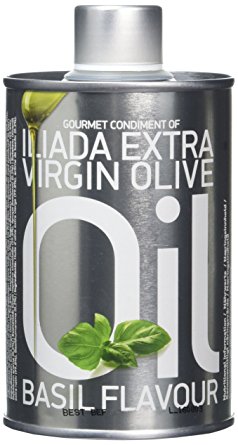
One can find the most fantastic extra virgin olive oil, of various tastes ( like olive and avocado oil), made by smaller producers, and sold in exquisite, luxury bottles.
 |
| Extra Virgin Organic Olive Oil from Messinia |
 |
| Extra Virgin Olive Oil in a Crystal Bottle |
 |
| Lamda Extra Virgin Olive Oil |
 |
| Greek Extra Virgin Olive Oil |
Olives are very nourishing, they protect our cardiovascular system and they help us lose weight. They might prevent cancer, decrease pain and improve the health of our digestive system and that our skin and hair. They, also, reduce allergies and increase antioxidants and nutrients. So do, please, eat a few olives a day!
Olive paste is a very tasty and healthy dip.
 |
| Black Olive Paste |
 |
| Green Olive Paste |
Olive oil by-products are various excellent kinds of margarine. Some of the latest are made with the addition of coconut and walnut oils.
 |
| Greek Margarine with Thick Yogurt |
 |
| One of the first Kinds of Margarine Made in Greece |
GREEK HONEY
 |
| Honeycomb Oozing With Golden Honey |
Honey and reduced grape must juice were the only sweetening agents in ancient Greece.
Greece has more beehives per acre than any other European country and Greek honey is considered one of the best in the world. It has many savours and properties, due to the diversity of the Greek flora.
Most of the kinds of honey are made from honeydew collected by the bees from fir and pine trees. One can also find honey flavoured with flower nectar such as orange blossom, heather and lavender, and herb flavoured honey like thyme and oregano.
 |
| A Popular Honey from Attica |
 |
| Highland Honey from Crete |
 |
| A Delicious Honey from Laconia Packaged in Black Elegance |
 |
| Thyme and Pine Honey from Crete |
 |
| Organic Thyme Honey in Luxury Glass Jar |
 |
| Fir Scented Honey from Vytina |
GREEK WINES AND SPIRITS
 |
| The Wine Map of Greece |
According to archaeologists, the first traces of wineries in ancient Greece and Europe were found in Philippoi, near Kavala, in the 5th millennium BC. Wine was then made with wild grapes. In southern Greece wineries were found in archaeological digs in Crete and were dated at the middle of the 3rd century BC. Wine drinking, in ancient Greece, was a social event, the symposium. But symposia were also organised, where intellectual, philosophical and political issues were discussed and solved while drinking wine.
During recent years, the Greek Wine Industry has improved tremendously, as large investments were made in modern oenological technology, so Greek wines have received more and higher awards in international competitions. Apparently, according to the connoisseurs, about 300 indigenous grape varieties, some of which have been cultivated since antiquity, are what make Greek wines unique.
The main kinds of wine in Greece are:
Agiorgitico is a grape that produces a luscious "velvety" red wine, with black cherry flavours. Since 2012 is the most widely cultivated red grape variety in Greece. The grape has traditionally been grown in Nemea, in the Peloponnese, but it can be found throughout the country, including Attica and Macedonia.
 |
| Agiorgitico Grapes |
 |
| One of my Favourite Red Wines |
Assyrtiko is a is a Greek white grape from Santorini, Paros and certain regions of Chalkidiki. Assyrtiko grapes grow in large clusters with golden-yellow skin and succulent flesh. Throughout Greece, the grape is vinified to make excellent dry wines and sweet dessert wines. One is called Vinsanto (wine from Santorini).
 |
| Assyrtico Grapes |
 |
| One of the Favourite Greek Wines |
 |
| A Dessert Wine from Santorini |
Athiri is an ancient white grape variety of the Aegean islands that produces excellent wines with lemon flavours.
 |
| Athiri Grapes |
 |
| Athiri from Rhodes |
Between the 4th and 5th BC, Aristotle excelled the grapes and wines of Limnos. Today, known under the name of Limnio, made from a red grape called Kalambaki, it gives very good red wines. Limnos is also famous for the whites, lemon flavoured, like the sweet Muscat of Limnos and the Muscat of Alexandria.
 |
| Muscat of Limnos |
 |
| Kalampaki |
 |
| An Excellent Wine |
 |
| A Sparkling Moschato |
 |
| A Muscat from Limnos |
 |
| Another Limnos Muscat |
Malagousia is an ancient variety that nearly became extinct but was fortunately revived by top producers and academics in the late 1970s and early1980s. The wine has "a peach, jasmine scented aroma".
 |
| Malagousia Grapes in Full Splendour |
 |
| A Wonderful Wine |
Monemvasia wines have a glorious past. They were, famous as Malvasia in the international markets, during the 13th century Byzantine Period until the 17th century, under the auspices of Venice.
Today, the wineries of Monemvasia extend to the former municipalities of Monemvasia, Asopos, Voion and Molai of Laconia. For the white PDO Monemvasia wines, apparently at least 51% Monemvasia grapes are used and a variable percentage of other varieties such as Assyrtiko, Adonitsa, Roditis, Feleri, Athiri, Aidani, Petrobuliones and Asproudes. While the red PDO Monemvasia is based on Thraspa, Mavroudi, Agiogitiko, Mandilaria.
 |
| Monemvasia/Malvasia Grapes |
 |
| Monemvasia Wines |
 |
| In Honour of a Legend |
 |
| Malvasia |
Mavrodaphne is a grape found in the Western part of the Peloponnese and the Ionian Islands. It is mixed with Corinthian currants to produce a delicious, fortified dessert wine.
 |
| A Cluster of Mavrodaphne Grapes |
 |
| No Comments... |
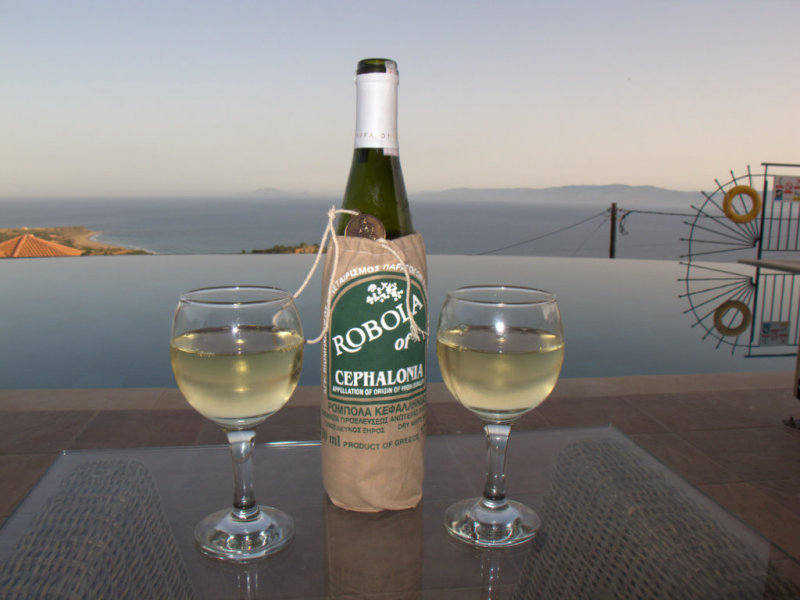
Robola, a grape grown mostly on the mountain slopes of Cephalonia produces a fabulous wine with peach and citrus aromas and a smoky aftertaste. Robola's fine character helped in its AOC (Appellation d'Origine Controller) Robola of Cephalonia
 |
| Robola Grapes |
 |
| A Delicious Greek Wine Robola of Cephalonia |
 |
| Cheers! |
Roditis pink skinned grapes, the most planted variety in Greece yield excellent wines, such as Patras nectar and other delicately perfumed wines. Mixed with Savatiano it is used for Retsina, the resin-scented Greek wine.
 |
| Pink Roditis Grapes |
 |
| Delicious |
 |
| Kethribari (Amber) Retsina |
 |
| A Delicate Muscat |
The island of Samos has a "remarkable wine heritage" since 1200 BC. Samos is famous for its muscat wines produced from the Muscat grape grown on the terraced slopes of Mount Ambelos. The main wines are Samos Vin Doux, Samos Grand Cru, Samos Anthemis and Samos Nectar.
 |
| Muscat Grapes of Samos |
 |
| The Famous Wines of Samos |
Xynomavro is the predominant grape of the variety of Macedonia. It grows mainly in N.W. Greece and is considered a noble grape, "intense and vibrant". The wine has a deep red colour with a rich tannic character and according to experts, it recalls herbs, cloves, dried rose petals, walnuts, tobacco and sun-dried tomatoes. It has an aftertaste of strawberries, raspberries, and cherries and also of kirsch, prunes and currants.
 |
| A Noble Grape |
 |
| Delicious Wines |
 |
| One of the Best Greek Reds |
 |
A Delightful Wine
An Excellent Wine from the Russian Monastery of Mount Athos
|
GREEK SPIRITS
Greek brandies, spirits and liqueurs are of high quality.
 |
| Metaxa VII |
 |
| An Excellent Brandy |
 |
| A Greek Aperitif |
 |
| Wonderful Greek Liqueurs |
 |
| A Citrus Liqueur from Naxos |
GREEK YOGURT
Yogurt is produced by the fermentation of milk by bacteria, the "yogurt cultures". These bacteria ferment the lactose of the milk and produce lactic acid, which is what gives yogurt its thick texture and special flavour.
In ancient Greece, there was a dairy product, known as "oxygala" which was eaten with honey. It was made with milk, thickened in a similar method with the one used today to prepare yogurt.
In Europe and the United States, cow's milk is more commonly used to make yogurt but it is also prepared by using goat's, ewe's and buffalo's milk. In some parts of the world, mare's and camel's milk are used to make this wonderful superfood.
Yogurt is rich in vitamin B12 and riboflavin, moderate contents of protein and selenium, a very nourishing and healthy nutrient.
Made all over Greece by small cottage industries but also by large dairy manufacturers, Greek yogurt is renowned and popular throughout the world.
 |
| Yogurt Prepared by Small Dairy Farms |
 |
| Since 1954 Fage Offers Excellent Strained Yogurt |
 |
| Greek Yogurt Exported All Over the World |
 |
| Another Greek Brand |
 |
| Mevgal Yogurt with Fruit |
GREEK CHEESE
Cheese is a nutrient made by the coagulation of casein, a milk protein. It is usually made from the milk of cows, buffalo, goats and ewes. The milk is usually acidified and then rennet, an enzyme, is added that causes the coagulation and it is, then, pressed into its final form and given enough time to ripen.
Cheese has many textures, flavours and styles. Some are soft and spreadable, others semi-hard table cheeses and some very hard for grating. Many kinds of cheese are flavoured with herbs or spices even with wood smoke. Others have mould on their rind, like Roquefort or Gorgonzola.
A few kinds of cheese are produced by acidifying the milk with vinegar or lemon juice then strained and pressed into shape. The liquid occurring from this procedure is whey, a by-product of cheesemaking which, apparently, has 50% milk solids, including most of the lactose and lactalbumin.
Whey cheese is a dairy product, made by coagulating the albumin in whey, with heat and possibly with acid. Well-known kinds of whey cheese are ricotta or mizithra.
According to Dr Pascalis Kastanas, the following are the main kinds of traditional Greek cheese, with DOC (Controlled Denomination of Origin). I have added Chevres of Metsovo and San Mihalis of Syros.
Anthotiro is an unsalted or slightly salted whey cheese made from ewe's or goat's milk. It has been prepared in Greece for many centuries. It is consumed as a table cheese or used for preparing sweet and savoury cheese pies and cheesecakes. If not packaged it must be used for a period of not longer than 3-4 days. A hard anthotiro is, also, produced by adding milk, cream and extra salt to the whey.
 |
| Packed Anthotiro |
Feta is the famous Greek cheese, dating back to antiquity. It is a white soft cheese, ripened and kept in brine for at least 2 months. It is kept in barrels or offered by large producers in attractive modern packaging. Apparently, the annual per capita consumption of feta in Greece is 12 kg, out of the total cheese consumption of 25 kg, which is the highest in the world.
 |
| An Excellent Feta |
 |
| Feta the Cheese of the Gods |
Formaella of Parnassos is a Greek cheese made in the vicinity. Floured slices of Formaella are fried in butter, in a special small shallow pan called sayanaki, until crisp and golden on both sides and soft in the middle. It is served drizzled with lemon juice and sprinkled with freshly ground black pepper.
 |
| Formaella of Arahova |
Galotiri, one of the oldest kinds of Greek cheese. It is made out of ewe's and goat's milk in the regions of Epirus and Thessalia. It is a spreadable table cheese, with a pleasant and refreshing taste.
 |
| Galotiri from Pelion |
Graviera of Crete is exclusively manufactured in Crete that ripens in, at least, five months. It is a high-quality hard cheese, with a slightly sweet taste and very pleasant organoleptic properties. It is considered a delectable table cheese.
 |
| A High-Quality Table Cheese |
 |
| Graviera from Crete |
Graviera of Naxos is manufactured, exclusively, in Naxos from cow's milk with small quantities of ewe's milk added. A high-quality table cheese with unique organoleptic properties.
 |
| A Wonderful Table Cheese |
San Mihalis of Syros is the most expensive Greek cheese, with a Protected Designation of Origin (PDO). A treasure of a cheese with a strong, spicy flavour, reminiscent of Parmesan, is produced in a small village of San Mihalis in the northern part of the island of Syros. It is made out of cows' milk and needs a four month ripening period. It is consumed as a table cheese but it can be grated and used in various preparations.
 |
| One of my Favourite Kinds of Cheese |
Kalathaki of Limnos a Greek cheese made from ewe's milk with small quantities of goat's milk in Limnos. It is a soft cheese, slightly sour and salty and has pleasant organoleptic properties, similar to those of Feta. It is a table cheese, that can be consumed in Greek salads, it can be used to prepare cheese pies and sayanakis.
 |
| Kalathaki of Limnos with a Sprig of Marjoram |
Kasseri is a Greek cheese made from ewe's and goat's milk in Macedonia, Thessalia, Lesbos and Xanthi. It is offered as a table cheese and is used to prepare pies.
 |
| Kasseri Brands |
 |
| Small Kasseri Cheese Pies Ready to be Baked |
Kefalograviera manufactured from ewe's and goat's milk in Macedonia, Epirus, Akarnania, Evritania and needs a three month ripening period. Its organoleptic properties are between Kefalotiri and Graviera. It is considered a table cheese but it can, also, be grated and prepared into a sayanaki.
 |
| Dodoni's Kefalograviera |
 |
| Krinos Kefalograviera |
Kefalotiri is prepared from Pasteurisied ewe's and goat's milk and is manufactured all over Greece, it is a hard, salty cheese and is considered the ancestor of all Greek hard kinds of cheese. It is a table cheese, that can be grated and, also, made into sayanaki.
 |
| Kefalotyri |
 |
| Packaged Kefalotyri |
Kopanisti is a Greek cheese exclusively made in the Cyclades Islands from ewe's and goat's milk. It is a soft cheese, very salty with a sharp and a rich flavour, reminiscent of Roquefort or Gorgonzola. It is consumed as a table cheese and can be used to prepare cheese pies and spreads.
 |
| Kopanisti from the Cheese-Dairy of Mykonos |
 |
| Kopanisti and Dill Spead |
Ladotyri is a Greek Cheese exclusively manufactured in Lesvos. It is known as Kefalaki (small head) due to its shape. It needs a three month ripening period and is preserved in olive oil. It is a hard table cheese with a strong flavour.
 |
| Ladotyri of Lesvos in Extra Virgin Olive and Peppercorns |
 |
| Grilled Ladotyri |
Manouri is an excellent whey cheese, exclusively manufactured in Central and West Macedonia and in Thessalia. It is made from the whey of ewe's and goat's milk and it is a soft cheese with a unique taste and flavour. A hard Manouri can also be prepared with the addition of milk and cream.
 |
| Manouri a Delicious Whey Cheese |
 |
| I Serve Manouri With Hot Crispy Bread and Quince Chutney |
Metsovone is a hard, smoked cheese manufactured in the region of Mestovo, in Epirus, from which its name derives. It is an excellent quality table cheese prepared with cow's milk but small additions of ewe's and goat's milk can be used.
 |
| A Delicious Cheese Flavoured with Wood Smoke |
 |
| A Green Salad With Pomegranate Seeds, Cashew Nuts and Metsovone Cheese |
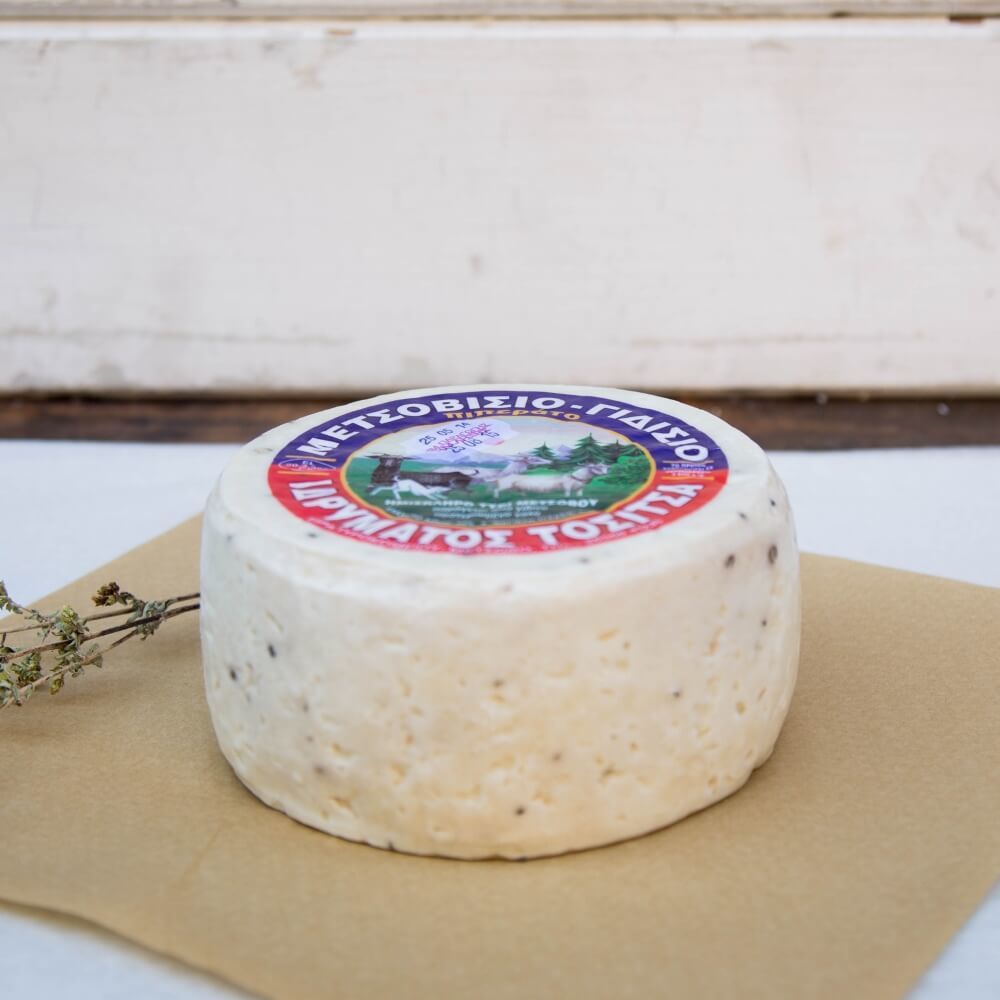
In Metsovo, north-western Greece the same inspired producer prepares an excellent chevre.
 |
| A Tositsa Chevre With Peppercorns |
GREEK CURED MEATS
Ancient Greeks, apparently, knew several methods of preserving meat. Later, in villages all over the country, people prepared sausages and smoked pork, and in order to get the highest quality of meat, they fed the animals with grass, herbs, acorns and grains. They would salt and smoke selected pieces of pork and preserve them in fat.
In the beginning of the last century, sausages and salamis started being prepared with names of origin, such as Lonza of Mykonos and Salami from Lefkada. After 1956, considerable efforts were made to modernise the cured meat production. But it was only in 1970 that modern cured meat factories were established.
When Greece joined the Common Market, in 1981 and the Greek Cured Meat Industry had to be adapted to European standards, fabulous new deli products were created that became famous both home and abroad.
 |
| Salami From Lefkada |
 |
| Salami from Lefkada |
 |
| Apaki from Mykonos |
 |
| Apaki from Crete |
Today, Greece is well-known for its various kinds of "loukanika" (sausages), some of which are of very high quality. Also, cured meats like the Cycladic "Lonza", the tasty and aromatic "Noubolo" from Corfou, know also as rustic prosciutto and "Zamboni" from the island of Naxos.
 |
| Leek Sausages |
 |
| Sausages in Olive Oil |
 |
| Sausages filled with Cheese |
Other preserved meat products are "Pictes" (meat in aspic), "Kavourma" and many more, made all over Greece. As mentioned above, the better-known products include Salami from Lefkada, Syglino from Mani and Apaki from Crete. Other delicious regional products are a gammon boiled in red wine and then smoked from Evritania, and a ham smoked with herbs and honey.
 |
| Kavourma from Northern Greece |
 |
| Gammon Cooked in Red Wine |
Large producers prepare excellent tasty hams from pork or turkey, flavoured with herbs and spices. Smoked bacons of excellent quality are also made.
 |
| Pork Ham |
 |
| Smoked Ham |
 |
| A Popular Bacon |
 |
| Excellent Buffalo Products Made by Inspired Producers |
 |
| Slowly Ripened Pancetta |
 |
| Ham Glazed with Honey and Herbs |
 |
| Ready-Made Meat Balls |
In northern Greece, there is a factory that produces turkey gammon smoked with pine and rosemary. They also prepare delicious sausages, pastrami and pastruma, made with beef and camel meat cured according to recipes from Asia Minor.
 |
| Pastruma in Piles |
One producer, whose facilities are in Piraeus with shops all over Greece is an expert and makes ten types of pastruma , including one made with buffalo meat and the classic camel variety.
 |
| Salami and Pastruma Hanging from the Ceiling |
Other delicacies are lightly smoked rabbit apaki and buffalo salami and kavourma made in Crete.
 |
| Cretan Kavourma |
Other regional deli products are smoked black boar fillet and smoked pancetta.
 |
Smoked Black Boar Fillet
{The Boars are Fed with Green Olives) |
 |
| Smoked Pancetta |
 |
| Black Pig Ham |
CURED AND SMOKED FISH, PICKLED SEAFOOD, TARAMA AND AVGOTARAHO
 |
| Fresco of an Ancient Greek Fisherman |
According to the archaeological finds, cooked fish was preserved in sesame oil, around 3.000 BC, in Mesopotamia. In 1.200 BC, the Phoenicians traded salted, dehydrated fish in the Eastern Mediterranean. Later, there is evidence that the Greeks, around 900 BC, already knew the techniques of preserving meat and fish with salt. The Romans, in 200 BC, having learnt the method of curing meat and fish from the Greeks, expanded the process of pickling and preserving. Later, fish, especially salmon was preserved with salt and honey, as the sweetness of honey or any other sweetening agent diminishes the sharpness of the salt.
 |
| Salted Dehydrated Cod |
As Greece has many fish farms and hatcheries, there are many preserving facilities all over the land.
Today, fish and seafood are preserved in Greece mainly by old, but modernised, curing methods i.e. with salt and smoke. But they are also tinned, vacuum-packed, frozen and pickled in flavoured vinegar.
Sardines, anchovies, mackerel, tunny fish, trout, prawns, octopus, squid and cuttlefish are preserved according to the methods mentioned above
 |
| Sardines in Spicy Oil |
 |
| Sardines in Olive Oil |
 |
| Anchovy Fillets |
 |
| Smoked Trout |
 |
| Smoked Makarel |
 |
| Sliced Baby Octopus in Vinegar |
 |
| Octopus Sun- and Air-Dried Before Being Grilled |
 |
| Frozen Greek Cuttlefish |
 |
Marinated Sardines and Anchovies
|
 |
| Frozen Fish from Kefalonia |
 |
| Greek Frozen Fish and Seafood, Exquisitely Packed |
 |
| Greek Prawns |
Although I have made great efforts, I cannot find out if tarama is produced in Greece. I decided to include it in Greek products, as taramosalata is a delicious and very popular Greek fish roe dip made from tarama, the tiny fish roe of carp, roe or mullet.
 |
| Red Tarama |
 |
| Taramosalata |
Avgotaraho is the Byzantine "ootaraxon" known under the name of bottarga. Avgotaraho Messolongiou, is made from the fish caught in the lagoons of Messolongi/Etolikon and is a Greek and European product with Protected Designation of Origin, there are very few fish products with a PDO.
 |
| Delicious Avgotaraho (Bottarga) |
When the female mullets are fished, the mature twin sacks of roe are carefully removed, thoroughly washed, salted and air-dried. When ready, they are covered with eight layers of beeswax, which protect the avgotaraho from oxidation and help to retain its humidity. It is a unique delicacy, served either thinly sliced, over buttered brown bread or grated over any hot pasta of your choice or over a large, zesty green salad.
DELI-MUSTARDS AND FLAVOURED VINEGAR
Mustard is a spicy relish produced from the seed of the mustard plants Sinapis Alba for the yellow mustard, Brassica Juncea for brown oriental mustard and Brassica Nigra for dark mustard.
Mustard seeds have been used for cooking purposes since prehistoric times. Plants were cultivated in Palestine and later in Egypt, some mustard seeds were, actually, found in the in the pyramids. Much later, Greek and Roman cooks used mustard powder in brine to flavour meat and fish dishes. By the 4th AD century, mustard was being produced and consumed in Gaul and the Kingdom of Burgandy. I was delighted to be reminded that Pope John XXII was so fond of this condiment, that he created a new position in Avignon, called Le Grand Moutardier du Pape (the Pope's Great Mustard-maker)!!
 |
| Pope John XXII |
 |
| A Mustard Maker (Obviously not the Pope's) |
In Greece, the fist producer of ready-made mustard was established in 1930. Then, the company offered only strong and mild mustards, now they have many kinds of mustards sweetened with honey and flavoured with Mediterranean herbs.
 |
| The First Greek Mustard |
Today, incredible mustards are made in Greece. On a large or a smaller scale, producers from all over the country offer the most delightful kinds of this condiment that are, internationally, considered as gourmet products.
 |
| A Traditional Mustard from Thessaloniki |
 |
| A Popular Brand |
 |
| Mediterranean Mustard with Herbs |
 |
| Delicious Mediterranean Mustard |
 |
| Mustard with Sun-dried Tomatoes and Capers |
Dressings with Mustard Honey and Avocado Oil
 |
| Greek Mustard |
 |
| Mustard Powder |
VINEGAR is a liquid composed of 5-20% acetic acid, water, traces of other chemicals and various flavourings. Acetic acid is produced by the fermentation of ethanol by acetic acid bacteria. Vinegar is used for cooking purposes and pickling.
In Ancient Egypt, vinegar residues were discovered in urns that are dated back to 3.000 BC by archaeologists. During biblical times, vinegar was used in cooking and, when diluted in water, it was considered an invigorating drink and also a medicine. According to the Old Testament, Ruth after working very hard in the fields was invited by Boar to eat bread dipped in vinegar.
 |
| By Julius Schorr von Corolsfeld |
One of the first kinds of vinegar, made in Greece was called Xidi Orleanis. Today, several are produced, flavoured with fruit, herbs and honey. A producer from Kalamata started making a balsamic vinegar which was made 100% Corinthian currents. Now they produce balsamic creams flavoured with orange and lemon, pomegranate, figs, strawberries and chilli BBQ. These delicious products help one to transform both traditional and modern dishes to "unique taste experiences".
 |
| Greek Balsamic Vinegar Flavoured with Fruit and Honey |
 |
| World's Excellent Product |
 |
| Hellia Balsamic Vinegar |
 |
| Wise Tree Vinegar |
 |
| A Popular Brand |
 |
| Five Year Aged Santorini Vinegar |
GREEK READY-MADE DIPS. SPREADS AND EMULSIONS
Greek ready-made dips, spreads and emulsions are of very high quality, such as taramosalata, skordalia (garlic sauce), tirokafteri (spicy feta dip), xtipiti (roast pepper and feta spread), melitzosalata (smoked aubergine salad), many kinds of sun-dried tomato spreads and ready-made tomato sauces, relishes and dressings.
 |
| Delicious Relishes |
 |
| Taramosalata |
 |
| Sweet Red Peppers |
 |
| Sun-Dried Tomato Spread |
 |
| No Comments |
 |
| A Delectable Aubergine Spread with Sun-Dried Tomatoes and Red Pepper |
 |
| Aubergine Salad with Smoked Tea |
 |
| Tomato With Honey Liqueur |
 |
| Mint, Thyme, Oregano, Tarragon, Dill and Basil in Olive Oil |
GREEK FRUIT JUICES
As we are blessed with a Mediterranean climate, the most luscious, aromatic fruit grow in this land. Evidently, there are several manufacturers in Greece producing first-rate fruit juices.
 |
| A Platter of Fruit by Georgios Iacovidis |
 |
| Fruit By Yiannis Stavrou |
 |
| Watermelon by Panayiotis Tetsis |
 |
| Summer Fruit and Music by Pavlos Samios |
 |
| Excellent Greek Fruit Juice |
 |
| Juices of all Savours |
 |
| Citrus Fruit Juice and Combinations |
 |
| To Your Health! |
 |
| Produced by a Large Department Store |
GREEK PASTA
The first advertisement I had seen on cinema, before World War II, was that of a famous Greek pasta company. A priest from a monastery was shouting out to a monk who was going to town for provisions, "Akakie, keep in mind that the makaroni you buy are Misko!"
 |
| A Vintage Advertisement |
Today there are several manufacturers of pasta in Greece, as we just adore it in all shapes and sizes. Also, there are small producers all over the country that make the most incredible dry and fresh pasta. I must mention "trahana", a small-sized Greek traditional pasta, made with flour milk and yogourt, produced by cottage industries and with which the most incredible winter soups can be prepared. Also, trahana can be prepared like a rice dish, with either meat, chicken or mushrooms.
 |
| Various Pasta Shapes |
 |
| The Oldest Producer |
 |
| A Popular Brand |
 |
| A High-Quality Pasta |
 |
| Excellent Pasta, Including Trahana |
GREEK PASTRIES
Because pies are very popular in Greece, high-quality ready-made pastries are produced in the country. Except for the very thin phyllo pastry, many other kinds of pastries, like kourou, kataifi, and puff pastry, are made in Greece. Most of these companies also prepare various kinds of frozen savoury and sweet pies, ready to be baked, a blessing for busy, hard working people.
 |
| Filo Pastry |
 |
| Puff Pastry Sheet |
 |
| Filo Pastry |
 |
| I Use these Small Puff Pastry Rounds Curry Puffs |
 |
A Versatile Shredded Pastry
Bite-sized Spinach and Feta Pies Made with Puff Pastry |
 |
| Ready Made Cheese Pie |
 |
| Individual Cheese Pies with Kourou Pastry |
 |
| Twisted Cheese Pie |
 |
| A Spinach and Cheese Pie from Metsovo |
 |
| Cocktails Sausages Covered with Puff Pastry |
 |
| Croissants Filled with Hazelnut Praline |
GREEK SWEETS AND ICE CREAMS
Traditional Greek sweets, are spoon sweets, Baklava, Cream Pie, Honey Puffs, but one can also find the most delicious chocolate desserts and ice creams made by master pastry cooks.
 |
| Pistachio Spoon Sweet |
 |
| Morello Cherry Spoon Sweet |
 |
| Watermelon Preserve |
 |
| Spoon Sweet with Garlic and Basil |
 |
| Spoon Sweet with Onion and Mint |
 |
| Spoon Sweet with Sweet Red Peppers from Florina |
 |
| An Old Brand with Excellent Preserves |
 |
| Aristitokratikon the Best Handmade Chocolates and Fondant |
 |
| Aristokratikon Delicious Milk and Dark Chocolates |
 |
| I Use This Bar for Chocolate Cakes |
 |
| A Greek Chocolate Praline |
 |
| Dark Chocolate filled with Cappucino Cream |
 |
Classic Praline Chocolates
|
 |
| Wonderful Greek Chocolate |
 |
| The Best Mille Feuilles in Athens |
 |
| Custard Cream Pie by a Famous Old Pastry Shop |
 |
| A Moist Chocolate Dessert by a Master Pastry Cook |
 |
| Milk Chocolate Delight with Dark Chocolate Roses |
 |
| A Chocolate Birthday Cake |
 |
| Ice Cream by Master Pastry Chef Stelios Parliaros |
 |
| Greek Frozen Yogurt |
 |
| Delicious Chocolate Ice Cream by Greek Master Chef Dina Nicolaou |
 |
| Dodoni - Frozen Yogurt |
 |
| Wild Cherry by Kri Kri |
* Recipes with these products will be given in a later post.