Monday, 31 August 2015

31st August 2015


                                                  Summer Flowers and Fruit


We have had a very eventful August, in Greece, this year.

Six months after Mr. Tsipras, the Greek ex-Prime Minister, was elected with false promises to overthrow austerity, he made a 180-degree turn.   With, only, a section of SYRIZA and the help of the  opposition, a new, extremely onerous memorandum was voted, in order to keep Greece in the Eurozone.

In a matter of weeks, SYRIZA’s left platform radicals, feeling betrayed, formed a new party LAIKI ENOTITA (POPULAR UNITY), the second left-wing party in Greece.    Mr. Tsipras, realizing that he could not rule without the help of the opposition, handed in his resignation to the President, Mr. Pavlopoulos, and proclaimed snap elections for the 20th September 2015.

Most Greeks were amazed and angered by the announcement.  The cost of these elections is estimated at 40 million euros.   According to the polls, the majority of the electorate is undecided while SYRIZA’s lead over NEW DEMOCRACY is diminishing to 1½ %.


The other great issue of our country is migration.   Nearly 200.000 people have landed in Greece, this year, mainly on the islands of Chios, Lesvos, Samos and Kos.   As a country, we cannot afford to look after these unfortunate people, the way we ought to.   Also, we neither have the means nor the number of expert personnel, for registering thousands of refugees.  

After the suspension of E.U.’s Dublin Regulation, by the end of this year, Greece will have to establish new registration centres, to register refugees and separate them from economic migrants.   This will be achieved with the help of experts from other countries of the European Union.


There were rumours that IS destroyed one of the most historically significant temples in Palmyra, the Temple of Bel, which was, fortunately, later denied by the Syrian Director of Antiquities.*

*1st September 2015.
Yesterday, there was conflicting information, concerning the destruction of the Temple of Bel, in Palmyra.   The World Heritage Site of Palmyra was captured by the IS militants, last May.   Since then, unbelievably tragic events have taken place.  Most of the personnel of the archaeological site has been brutally murdered by the savage, cowardly jihadists.  Recently, they beheaded a famous Syrian archaeologist and destroyed the 2000-year gem, the Temple of Baal.

Unfortunately, today, a satellite image confirms the rumours, that the main building of the Temple of Bel has been blasted to rubbles, by the IS barbarians.   


In Kiev, a national guard member has been killed and over 100 injured in violent protests outside the Ukraine Parliament.


                          The full Moon and the Parthenon


                         The full moon and Cape Sounion


                         The full moon from Yianna's and Spiros' terrace in the Castle
                         of  Monemvassia


And, finally, something romantic.   Last Saturday, the August full moon was celebrated, across Greece.   Many museums, archaeological sites and monuments stayed open until midnight, presenting many events and happenings, free.


My dear friend Joanie offered us htapothi me kofto makaronaki (octopus with short pasta), for our bridge lunch.   Being inspired by Joanie’s delicious main dish, I decided to give you a few recipes for octopus, on this post.

A very familiar image on any Greek island is a fisherman bashing an octopus on a rock.  This act has been performed throughout long millenniums, in order to tenderize octopus.  The saying goes that at least ninety-nine hard beatings are needed, for it to become tender, when cooked!!

Here is a newer method that works wonders. According to experts it “denatures the protein” and renders the octopus tender when cooked. 

Bring a large saucepan of salted water to the boil.  Squeeze in a lemon, add a twist of lemon rind, a slice of fresh ginger root, a bay leaf, a star anise and 1 teaspoon of whole peppercorns.    With the help of tongs, dip the cleaned and trimmed octopus 3-4 times into the boiling water until the tentacles harden and curl.  Then submerge it into the water and simmer for 40-45 minutes or until it becomes tender.   Remove the slackened dark skin from the tentacles, leaving the suction cups on, and continue cooking the octopus any way you wish.  Strain and reserve the very tasty cooking liquid.


                                     BOILED  OCTOPUS WITH LATHOLEMONO
                                             (OIL-AND LEMON DRESSING)


This is the way that my husband preferred eating octopus.

1½ kg (3 lb) boiled octopus (please see above), dark skin removed, sliced into small bite-sized pieces
1 tbsp vinegar

Latholemono dressing:
1 tbsp lemon juice or more if preferred 
The grated rind of ½ lemon
1 tsp mustard
Salt and freshly ground black pepper to taste
3 tbsp olive oil

Garnish:
1 tsp dried oregano or thyme
½ cup sliced olives
1 heaped tbsp capers


Sprinkle the hot octopus slices with vinegar, cover with cling film, and set aside to cool.  

Meanwhile, prepare the dressing.   Stir the lemon juice and rind with the mustard, salt and pepper, until the salt dissolves then, slowly, add the olive oil and beat until the dressing is thick.

Drizzle the cold octopus slices with latholemono, sprinkle with oregano or thyme, garnish with olives and capers, and serve. 


                                          OCTOPUS WITH RICE SALAD


This is a most appetizing and colourful salad that most people enjoy.

4 cups cooked basmati rice
500 kg (1 lb) boiled octopus (please see above), thinly sliced and drizzled with a little dressing
3 spring onions, chopped finely in a slant
1 red pepper, seeds and ribs removed, diced
1 yellow pepper, seeds and ribs removed, diced
1 cup blanched, roasted almonds, roughly chopped
I cup raisins

Dressing:
2 tsp vinegar
2 tsp lemon juice
1 tsp mustard
1 tbsp honey
Salt and pepper to taste
Almost 63 ml (1/3 cup) olive oil
(Mix the first five ingredients together, then beat in the olive oil, until thick)

Garnish:
Whole parsley leaves and
chive stalks, snipped


You could boil the rice in the reserved octopus stock, if you prefer a more vigorous taste.
Mix the cold rice, carefully but thoroughly, with the other ingredients and the remaining dressing.  Reserve a few octopus slices for garnishing.  Mound the rice salad on a serving dish, place the remaining octopus pieces, decoratively, on top and sprinkle with parsley and chives.


                                CYPRIOT TAHINI SAUCE WITH BOILED OCTOPUS


If you like tahini, try making this salad.   As I have mentioned before, tahini is a paste made out of sesame seeds, that apparently is an excellent source of magnesium and omega 3 and 6 fatty acids.  It also has high levels of calcium and protein. 


One 1.250 kg (2½ lb) octopus, cooked according to the first recipe on this post

Sauce:
3 slices stale bread, crusts removed, cut into pieces
2 cloves garlic
45 g (1½ oz) walnuts
Salt and freshly ground black pepper

4 tbsp tahini
Salt and freshly ground black pepper
½ tsp medium curry powder or more if preferred
120 ml (4 fl oz) lemon juice
2 tbsp chopped parsley

Garnish
A small frizé salad

First prepare the sauce.   Blend the garlic, bread, a pinch of salt and walnuts until a thick paste is formed, and scrape it into bowl.    Add the tahini, curry powder and the lemon juice by the spoonful, blend and taste and correct the seasoning, if necessary.   If the paste is too thick thin it down with a little water.  Place into a pretty bowl, sprinkle with parsley, cover with cling film and refrigerate.

Place the sliced octopus over an interesting, small frizé salad and serve it with the tahini sauce.     


                                      OCTOPUS WITH FENNEL AND WINE


Fennel bulbs are cultivated broadly in Greece.   They are popular and appear in many Greek contemporary dishes. This dish is based on an old Cretan recipe cooked with tomatoes, wine, and masses of wild fennel leaves.

1.5 kg (3 lbs) octopus, cleaned and thoroughly washed
250 ml (1 cup) dry white wine
1 star anise
4-6   peppercorns

85 ml (an ample 1/3  cup) olive oil
2 medium onions,  finely chopped
3 spring onions, finely chopped
4 fennel bulbs, trimmed and quartered (from
                         stem to root), stalks peeled

1-2 tbsp flour
1 cup or more vegetable stock (made with 1 carrot, 1 onion, 2 celery stalks 1 garlic
                                             clove, 1 star anise, chopped fennel leaves, salt and pepper                                    
                                                                 
 The juice of ½ a lemon

½ cup finely chopped fennel leaves
1-2 tbsp or more ouzo

Place the octopus in a pressure cooker and cook, uncovered, until the octopus releases its juices.  Lock the lid and simmer for about 6 minutes, then uncover, turn the octopus over, add the peppercorns and a little wine, the star anise and cook for another10-12 minutes with the lid locked.   By this time it should be cooked. If not, give it some extra time.  If you use an ordinary saucepan, the cooking time should be around 50 minutes to 1 hour.   Remove the dark membrane but not the suction cups from the octopus, cut it into bite-sized pieces, and reserve.

 Sauté the onions in olive oil, until soft.   Add the fennel bulbs and cook for 5 minutes. Stir in the flour, and cook for 5 minutes to prevent the taste of raw flour.  Then pour in the lemon juice and vegetable stock, and simmer covered, for about ¼ hour or until the bulbs are just cooked, stirring once or twice.   Add the octopus pieces, sprinkle with the fennel leaves and cook gently for another five minutes.   Finally douse with ouzo and simmer a few minutes more until the alcohol evaporates.  Taste and adjust seasoning with salt, if necessary, and freshly ground pepper.   Serve with iced ouzo.


                                                             GRILLED OCTOPUS
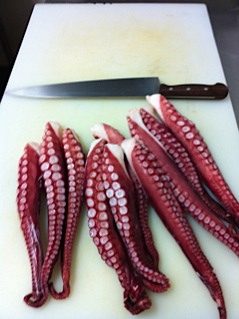


I first tasted this delectable bite in Chalkis, Evia, so many years ago.

1½ kg (3 lb) hot. boiled octopus, tentacles separated

Marinade:
3 tbsp olive oil
1 tbsp vinegar
1 tsp salt
1 tsp oregano or thyme

Garnish:
Lemon wedges

In a large bowl, mix the marinade ingredients well together and place the hot octopus tentacles within.   Marinate for 15 minutes at least, and grill the octopus for 10-15 minutes, turning every 5 minutes, or until the tentacles are crisp and slightly brown.  

Slice each tentacle, thinly, garnish with lemon wedges and serve with crusty, warm brown bread and a glass of ouzo.

    
                                                    OCTOPUS STIFATHO


Stifatho is as typically Greek dish which is very popular throughout the country.


2 kg (4 lb) raw octopus, trimmed and thoroughly washed
1½ kg (3 lb) shallots, blanched and peeled

Sauce:
125 ml (½ cup) olive oil
2 medium onions, finely chopped
2-3 cloves of garlic, peeled and finely chopped
250 ml (1 cup) good quality red or white wine
4 ripe tomatoes, halved, de-seeded and grated, skins discarded
1 tsp sugar
1 bay leaf
1 anise star
2-3 tbsp vinegar or according to taste
Salt and freshly ground black pepper


Place the octopus in a saucepan and cook over medium heat until it releases its juices.   Lower the heat, cover the saucepan and cook the octopus in it’s own juices until almost soft, about 30 minutes.   With a slotted spoon, place the octopus on a dish to cool.    Then remove the dark skin, but not the suction cups, and cut the octopus in small bite-sized pieces.

Meanwhile, in a large saucepan, sauté the shallots in olive oil, until slightly golden, remove with a slotted spoon, sprinkle with a little salt, and reserve.

Sauté the chopped onions, in the same olive oil, until soft.   Add the octopus and the chopped garlic, stir for 2-3 minutes and pour in the wine.  Cook, stirring for 4 minutes until the wine evaporates.   Add the tomato pulp, sugar, bay leaf, anise star, and carefully spoon in the shallots. Sprinkle with very little salt.  Cover the stifatho with a piece of baking parchment and the lid and simmer very, very gently for about half an hour or until both the octopus and shallots are tender, but not falling apart. 

Remove the saucepan from the fire, add a spoonful of vinegar, taste and add freshly ground black pepper and more salt, sugar and vinegar, if necessary.   Simmer for 5 minutes more.

Serve either with rice or with chips. 


                                                 PICKLED OCTOPUS


Offer fine slices of pickled octopus over an interesting salad.

3-4 kg (6-8 lb) octopus,
3-4 tbsp coarse salt

Cooking liquid:
250 ml (1 cup) white wine
1 onion quartered
6 garlic cloves, peeled
2 bay leaves
1 slice fresh ginger root, peeled
2 pieces star anise
1 tsp fennel seeds

Pickling mixture:
500 ml (2 cups) vinegar
500 ml (2 cups) water

3 cloves garlic
3 bay leaves
3 pieces star anise
1 tbsp peppercorns
6 small chilies (optional)


Massage the octopus with salt and after 15 minutes, rinse it thoroughly with water.

Bring the cooking liquid to the boil add the washed octopus and enough water to cover, if necessary.   Simmer for 40-50 minutes or until the octopus is tender.  Remove from the heat and let the octopus cool in the liquid.

Strain the octopus, remove the dark membrane and separated into tentacles.   Then cut into pieces or leave whole, and pack into sterilized jars.

For the pickling mixture, bring the vinegar and water to the boil.   Divide the garlic cloves, bay leaves, star anise, peppercorns and chilies, if using., among the jars.   Then pour enough of the hot vinegar/water mixture to cover.   Seal and store the jars in dark, cool place for 24 hours at least, before serving.   Once opened, place the jar in the fridge, and use for, not later, that one week.

Serve, thinly sliced over interesting salads, like the ones given below.


                                            CRACKED WHEAT SALAD


This is my favourite recipe for a cracked wheat salad.   It has more herbs and vegetables that the traditional recipe and can be served both as a first or a side dish.

120 g cracked wheat, soaked in vegetable stock, for 30 minutes, and strained
250 g (½ lb) firm tomatoes, skinned, deseeded and diced
1 cup chopped parsley
2 tbsp chopped mint
2 heaped tbsp finely cubed yellow and red peppers
4-6 spring onions, finely chopped
4 tbsp lemon juice or according to preference
The grated rind on 1 lemon
Salt and freshly ground black pepper
1/8 tsp Cayenne pepper
4-6 tbsp olive oil

Pat the strained cracked wheat with a kitchen towel to remove any moisture and place in large bowl.  Add all the remaining ingredients and toss gently but thoroughly, cover and place in the fridge overnight.

Just before serving, taste and add salt, pepper and lemon juice, if necessary and stir.  Serve the salad garnished with tender cos lettuce leaves.


                      FENNEL BULB ORANGE AND LETTUCE SALAD


Do prepare this lovely salad.

A cos lettuce, shredded
1 large fennel bulb, very finely sliced
1 large orange, filleted
1-2 spring onions, finely chopped in a slant
A few fennel sprigs, chopped

Dressing:
1 tbsp lemon juice
2-3 tbsp orange juice
Salt and pepper
1 tsp mustard
1 tsp honey
125 ml (½ cup) olive oil


First make the dressing.   Stir the first 5 ingredients very well together.   Then pour in the olive oil gradually, whipping until the dressing thickens.

Place the lettuce in a salad bowl,, arrange the sliced fennel bulbs on top and garnish the orange, evenly, on top.   Sprinkle with spring onions and chopped fennel sprigs, drizzle with salad dressing and toss the salad.




Wednesday, 12 August 2015

COOKENJOY IS THREE YEARS OLD


                                               Happy Birthday COOKENJOY!!


During these last three years, I shared with you, many happy memories.   I also commented on tragic events  such as wars, earthquakes, violence, atrocities and unprecedented  acts of terrorism that occurred and occur throughout my long life.

However, the essence of this blog is food, one of the great pleasures of life that magically unites and binds families, friends and people of various nationalities and convictions.


Here are a few recipes to celebrate my blog's third birthday.


                                 INDIVIDUAL MOULDS OF SMOKED FISH MOUSSE


This is a lovely way to start a meal.  This mousse is quite different from the one I gave you two years ago.

250 g (½ lb) fillets of sole, poached for 5-6 minutes in a wine court bouillon and placed on kitchen paper to dry (for the wine court bouillon recipe, please see below)

250 g (½ lb) smoked salmon
¼ tsp cayenne pepper
1 tsp finely grated lemon rind
The juice of 1 lemon
Very little salt
1 tbsp Dijon mustard

6 gelatin sheets, soaked in iced water for 5-6 minutes 
125 ml (½ cup) hot wine court bouillon

500 ml (2 cups) full cream, whipped to the soft peak stage
Salt and pepper according to preference

12 moulds lined with clingfilm
Or use a 12 socket cupcake tin

120 g (4 oz) red caviar ( We call it "brique" in Greece)

Wine Court Bouillon:
250 ml (1 cup) white wine
125 ml (½ cup) water
1 leek, sliced lengthwise, washed and cut into 4 pieces
1 carrot, scraped and thinly sliced
2 stalks tender celery
½ bay leaf
2 – 4 fine lemon slices
1 tsp peppercorns

(Boil the vegetables  for 7 minutes. After poaching the sole fillets, strain the stock, reduce it a little, and keep warm)


Blend the first seven ingredients until smooth.   Squeeze the gelatin sheets with your fingers, in order to remove as much water as possible, and stir vigorously to dissolve it in the reserved hot wine court bouillon, and blend thoroughly until well combined with the fish mixture.

Fold the whipped cream into the mixture until it obtains a homogenous consistency.   Taste, and correct the seasoning.  Be sparing with salt, as the mousse will be garnished with red caviar.

Cover the cupcake tin, lightly with cling film, pushing it with, a small glass, into the sockets.    Fill the sockets to the brim with the mousse, and cover with cling film.   Place a tray over, and refrigerate overnight.

When ready to serve,  remove the cling film and invert the cupcake tin on the tray, remove the second cling film very carefully, and with a flexible spatula, arrange the little mousses on a bed of  green salad on an iced dish.   Cover each mousse with a teaspoon of red caviar.  Serve with warm buttered toast.


                                                          PRAWN FRITTERS


This dish reminds me of Greek summers.  You could serve it either with a Tartar sauce or just with lemon wedges.


24 prawns, shelled (tails left on), deveined, washed and dried

Batter:
180 g (6 oz) self-raising flour
A good pinch of salt
1 1/2  tbsp melted butter
1 large egg, beaten
180 ml (6 fl oz) beer

1 egg white, whipped to soft peaks

Corn oil for deep frying

In a large bowl, sift half the flour and salt and stir in the butter and the beaten egg.   Gradually, pour in the beer and stir until the batter is smooth.  Cover the bowl and set aside, at room temperature for about half an hour.

When ready to fry, fold the whipped egg white into the batter until no streaks are visible.
Pour the oil into a wok and bring it to medium heat.    Holding each prawn by the tail, dip it first in the remaining flour, shaking off the excess, then dip it in the batter, allowing the surplus  batter to drip off.    Fry 5-6 prawns at a time for about 4-5 minutes until puffed and golden.  Drain on kitchen paper and keep warm.   Serve with tartar sauce, lemon wedges and a green salad.


                                               FISH MOUSSE WITH PRAWNS


This is another interesting starter.

300 g (10 oz) prawns, shelled and de-veined, slightly cooked with a twig of rosemary, and sprinkled with a little salt

800 g (1 lb 10 oz) fillets of sole, boned washed and dried
1 large onion cut into chunks
2 cloves garlic

5 large eggs
180 ml (6 fl oz) full cream
3-4 heaped tbsp dried bread crumbs
3 tbsp parsley, finely chopped
Salt and pepper to taste

Melted butter

Garnish
A few prawns fully cooked, green asparagus, fresh parsley leaves, thinly cut lemon slices.


Blend the sole with the onion and garlic cloves until smooth.   Add the eggs, cream and dried bread crumbs and blend until a light, homogenous consistency is obtained.   Fold in the chopped parsley and season with salt and pepper according to choice, it should be very tasty.

Preheat the oven to 180 C (350 F).  Line a loaf tin with lavishly buttered baking parchment, leaving enough hanging over.   Spoon in half the fish mixture, level the surface and arrange a layer of half-cooked prawns, on top.   Cover with the remaining fish mousse and even the top.  Brush the fish lightly with melted butter and cover with the baking parchment that is hanging over.  Cover the top of the tin with foil.   Place it in a deep baking tin, pour in enough hot water to come half way up the sides of the loaf tin and bake for about 45 minutes or until a skewer, inserted in the middle of the mousse, comes out clean.  Meanwhile cook the remaining prawns to perfection.

 Remove the loaf tin from the oven, unfold the parchment that is covering the mousse and reverse it on a pretty dish.  Garnish according to preference, and serve with a flavoursome green salad.
                   

                                            CHICKEN COOKED IN WHITE WINE


This is a main dish that your family and guests will really enjoy.

4 chicken breasts, skinned, boned and cut into bite-sized pieces
4 chicken legs, skinned and divided into drumsticks and thighs
Salt and freshly ground white pepper

10 rashes lean bacon

4 tbsp olive oil
2 tbsp softened butter

3 leeks, slit lengthwise, washed and finely chopped
4 spring onions, finely chopped
1 slice fresh ginger, peeled


125 ml (½ cup) brandy
One 750 ml bottle white wine
500 ml (2 cups) tasty chicken stock
1 bouquet garni (1 bay leaf + 2 sprigs thyme + 2 sprigs sage)

500 g (1 lb) champignons mushrooms, trimmed and halved or quartered
1 small onion, finely chopped
1 clove garlic
1 heaped tbsp plain flour or more if necessary
375 ml (1½ cup) tasty chicken stock

250 ml (1cup) cream

Finely chopped parsley for garnish.


In a large deep frying pan sauté the dried pieces of chicken in olive oil and butter for 2 minutes on each side for the breast pieces, and 4 minutes for the thighs and drumsticks.   Sprinkle with a little salt and freshly ground white pepper and place on a dish.

 In the same frying pan, cook the bacon until crisp and transfer to the dish with the chicken.   Remove most of the olive oil and butter and reserve.   Stir in the leeks, spring onions and ginger and cook over low heat until the leeks and onions are soft and the whole kitchen is filled with the aroma of ginger.

Arrange the chicken and bacon over the leeks, drizzle with brandy, and cook for 5 minutes until the alcohol evaporates.    Pour in the wine, simmer for 2 minutes, then add the chicken stock and the bouquet garni.   Sprinkle with a little salt and freshly ground pepper and cover the pan and simmer for 20 minutes.  Check the breast pieces and transfer to a dish, if cooked through.   Simmer the legs for 20 to 30 minutes more.   Bone the legs and add the brown meat next to the breast pieces. Also remove the bacon pieces with a slotted spoon.

Sieve the sauce into a large saucepan, pushing the vegetables with the back of a soup ladle, to extract the juices.     Place the chicken pieces and bacon into the sauce, and set aside.

Meanwhile, brown the mushrooms with a little of the  reserved olive oil and butter mixture until the mushrooms are dry, remove with a slotted spoon and place on a dish.   Sprinkle with a little salt.   Sauté the chopped onion and garlic until the onions are soft and translucent, sift the flour over and stir, over low heat, for 3-4 minutes.   Pour in the chicken stock, stirring constantly and simmer the sauce for 12 minutes until no taste of flour is evident.  Taste and add salt, if necessary, and white pepper.    Sieve the sauce, pushing the onions with the back of a soup ladle, and pour back into the saucepan.   Add the mushrooms and cook for 15 minutes more.

Pour the mushrooms into the chicken stew and mix well together.  Cool and refrigerate.

The next day, bring the chicken to the boil, taste and correct the seasoning with salt and pepper, if necessary.   Stir in a cup of cream and heat but do not boil.   Serve with smashed potatoes and cream and a zesty green salad.


                                  LAMB WITH WINE AND AVGOLEMONO SAUCE


This lovely dish is very popular all over Greece.


1 kg lamb, shoulder or leg, trimmed of all visible fat, cut into serving pieces
Salt
Freshly ground black pepper
2 – 3 tbsp plain flour
Olive oil,
2 tbsp butter

4 spring onions, finely sliced
1-2 cloves garlic, finely chopped
250 ml (1 cup) white wine
750 ml (3 cups) or more meat stock
1 bouquet garni (1 bay leaf + 1 sprig sage + 3 sprigs parsley)

2 egg yolks
Lemon juice to taste, (about 1 lemon)

2 tbsp parsley, finely chopped

Sprinkle the meat with salt and pepper and coat it evenly with flour, shaking off the excess.

Cover the bottom of a large, flat saucepan with olive oil and butter and sauté the meat in batches until slightly brown.

Pour off all fat but a thin film from the saucepan and stir in the spring onions and garlic and cook gently until the onions soften.   Arrange the lamb over the onions, pour in the wine, and cook for 3-4 minutes stirring and scraping any brown bits clinging to the saucepan.   Add the bouquet garni and the meat stock   Bring to the boil, cover the saucepan and simmer for about 1 hour or until the meat is tender.

With a slotted spoon, transfer the meat to a dish and keep warm.   Discard the bouquet garnit, strain the braising stock through a fine sieve and remove the fat from the surface.

Return the stock and meat into the saucepan, bring to a gentle boil, until well heated then remove the saucepan from the stove.   Meanwhile, beat the egg yolks with the lemon juice for 2-3 minutes.  Add a ladleful of hot stock into the egg yolk and lemon mixture, whipping constantly.   Add a second ladleful of stock, repeat the same procedure and pour over the lamb, shaking the saucepan vigorously.    Reheat, without boiling or covering the saucepan.   Serve with chips or steamed rice, and sprinkle with chopped parsley. 


                                GINGER AND MOCK LEMON CURD CHEESECAKE


   If you like ginger, this cheese-cake will be a treat. 

Pastry:
125 ml (½ cup) melted butter
100 g (½ cup) sugar
A pinch of salt
31 ½ ml (1/3 cup) orange juice
250 g (½ lb) self raising flour, mixed with
½ tsp ginger powder
1 tsp baking powder
½ tsp bicarbonate of soda


Filling:
Two 200g (almost 7 oz) tubs light cream cheese

(Mock lemon curd:
One 397 g tin sweet condensed milk
2-3 tsp lemon juice or more
The grated zest of 1 lemon
Mix everything well together until thick and glossy)

One 200 g (almost 7 oz) tub Greek yogurt
250 ml (1 cup) thick cream, whipped to the soft peak stage

2 pieces ginger stems in syrup, strained and finely chopped
4 tbsp ginger syrup (from the stem ginger jar)
3 tbsp water
6 gelatin sheets, separated and soaked in iced water to 5-6 minutes


Begin with the pastry.  Mix butter, sugar and salt until pale and fluffy. Stir in the orange juice until well combined and then the flour mixture until a soft pliable dough is formed.   Cover the dough and refrigerate for at least 30 minutes.

Roll out the pastry between two sheets of baking parchment and line the bottom of a 29 cm (11.2 inches) buttered spring-form tin.   Prick the pastry, all over, with the prongs of a fork and bake in a oven preheated to 180 C (350 F) for about 20 minutes or until the pastry is crisp and golden.   Remove from the oven and cool.  Make a few biscuits with the remaining dough, bake for 10-12 minutes and reserve.

Mix the cream cheese with the mock lemon curd and the yogurt until well combined and
fold in the chopped stem ginger and the whipped cream.  Heat the ginger syrup and water just below the simmering point, and remove from the fire.   Squeeze as much water as possible from the gelatin sheets, place in the ginger syrup and mix vigorously until they are completely dissolved.   Fold the gelatin/ginger syrup thoroughly into the filling, pour it over the pastry and level the surface.   Cover the spring-form tin with cling film and ice for at least 5 hours or overnight.

When ready to serve, remove the removable part of the cake tin and place the cheesecake on a pretty dish.  Garnish with crushed reserved biscuits or just drizzle with ginger syrup. 


                                 CHOCOLATE AND VANILLA ICE CREAM CAKE


This is a lovely dessert, so please prepare it.   You could even use good quality ready made ice-creams.


Chocolate Ice Cream:
456 ml (1 large + 1 small tins) sweet condensed milk
100 g (3 + 3/10 oz) dark chocolate, melted
375 ml (1½ cup) milk
A good pinch of salt
1½ tsp vanilla extract
600 g (1 lb 3oz + 1 tbsp) double cream, whipped to the soft peak stage


Vanilla Ice Cream:
300 g (10 oz) sugar
750 ml (3 cups) full-fat milk
A good pinch of salt
1 vanilla pod, slit in half
750 ml (3 cups) full-fat cream, whipped to the soft peak stage

First prepare the chocolate ice cream.   Mix the condensed milk with the melted chocolate, milk, salt and vanilla, thoroughly together.   Then fold in the cream, until no streaks of white are evident.
Place in a covered ice cream tray and freeze for 2 hours, at least.  Remove from the ice cream tray, whisk the ice cream vigorously, return to the tray, cover and freeze.   Repeat the procedure twice more.

For the vanilla ice cream, gently heat the milk with the sugar, salt and vanilla pod to the boiling point, stirring from time to time, until the sugar melts.   Then remove from the fire and let milk/sugar mixture cool.  Discard the vanilla and fold in the cream.
Place in a covered ice cream tray and place in the freezer.   After two hours remove the ice cream from the freezer, place in a bowl and whisk with an electric mixer, return to the ice cream tray, cover and freeze.   Repeat the procedure twice more, at two hour intervals. 

Sprinkle cake tin (28 cm (11.2 inches) in diameter and 6 cm (2.4 inches) deep) with sunflower oil.  To assemble the ice cream cake, remove the chocolate ice cream from the freezer to soften it a bit. Then spread thicky over the bottom and sides of the prepared cake tin (it doesn’t have to be perfect, that’s the beauty of it!).  Cover both the ice cream tray and the cake tin and freeze for 1 hour. 

Then add some of the vanilla ice cream in the middle, following the same procedure.  After two hours cover with chocolate ice cream, which should almost reach the cake tin’s brim.    Cover and freeze for at least five hours.   Just before serving, remove the tin from  the freezer, dip the bottom of the tin in hot water and reverse the ice cream cake on to a serving dish.   Garnish with chocolate curls.


Sunday, 12 July 2015

AGONY AND FEAR


                                    Greece the tenth star on the E.U. flag.


12th July, 2015.   The night was dark and restless and matched our deep anxiety and a profound sense of foreboding concerning our country's economic and social devastation.

13th July 2015 – 2.2 am.  This is another sleepless, dramatic night.   

Yesterday, the Eurogroup with the meeting of the nineteen finance Ministers of the Eurozone, Mr.Draghi of the Central European Bank and Mrs. Lagarde of the International Monetary Fund came to a second standstill.   There was no press communiqué, showing that they were far from an agreement.

Rumours leaked out, which were later confirmed, that the German side distributed non-papers indicating that there should be a five-year GREXIT and that Greek assets, valuing up to 50 billion Euros, should be accumulated in a fund in Luxembourg in order to repay our debtors.   Fortunately, most of the others did not agree with this disgraceful proposal.


As incongruous, dramatic events are changing from moment to moment, allow me to present them to you, chronologically.

Please refer to my previous post, The Greek Referendum, the results of which were 61.2% OXI – NO, a great shock to many Greeks and other Europeans.  According to analysts, not only did SYRIZA and their junior partner ANEL vote OXI - NO for Europe, but so did Golden Dawn, a party of the extreme-right  and various eurosceptics, such as the big capital, certain banks and opportunists who thrive on chaos and anarchy.


On the 8th July, 2015, Mr. Tsipras attended a plenary session of the E.U. Parliament, in Strasbourg, concerning Greece. 

 He first gave a speech, where he explained to the Euro-parliamentarians the Greek Government’s aims. 

He said that the OXI -  NO referendum result mean that 61.2% of the Greek population voted NAI - YES for the E.U. and the Eurozone.

The Greek Government should be the only one to determine the financial policy that will be followed in Greece.

He insisted that the deal should include a debt relief and that the Greek economic crisis was also a  European problem.

Amongst boos and applauds, he continued that “ the money given to Greece, never went to the people.   The money was given to save Greek and European Banks".

Mr. Tsipas’ speech urged mixed responses from the E.U. M.P.s.

Mr. Manfred Weber, the European Popular Party’s leader, made a scathing assault
against Mr. Tsipras, accusing him of deceiving the Greeks and trying ardently for a rift with Europe, despite his pretensions to the contrary.  Although, I did not vote for SYRIZA, I agreed with certain of the issues that Mr.Weber  presented and I’m accustomed to political jargon, I was extremely angry with him, because he insulted the Greek Prime Minister and with a stentorian voice, he sounded like harsh and very rude Public Prosecutor.

The leaders of the French and English Europhobic parties of the extreme right, both urged Mr. Tsipras to a  GREXIT, for very obvious reasons.

Mr. Guy Verholfstatd the Belgian ex- prime-Minister presented his opinions and asked his colleague, Mr. Tsipas, if he wanted to be remembered “as an electoral accident …. or as a revolutionary reformer?”

Gianni Pittella of Italy, struck another chord.   “For us, Social Democrats,” he said, “Europe without Greece is unthinkable.”

In his reply to the E.U. M.P.s, Mr. Tsipras, maintained  that the Greek crisis was a European problem.  He urged on a Greek debt reduction, and reminded his audience that, the strongest example for solidarity was, when in 1953, many Western European governments, including Greece, decided to write off 60% of Germany’s post-war debt.    This action allowed the country to overcome “the devastations of war and enjoy a long period of prosperity”.   

On the 9th July, the Government Council gave the Prime Minister, Mr. Tsipras, the authority to present the Greek proposals to our creditors.    The Prime Minister told his cabinet that he decided to choose an agreement, because otherwise a GREXIT would be inevitable.

The MPs of all the political parties are in a state of emergency.


On the 10th July, the Greek Parliament initially authorized the Prime Minister, Mr. Tsipras, the vice-President of the Government, Mr. Dragasakis and the new Minister of Finance Mr. Tsakalotos to negotiate the Greek proposals with our creditors.


The Eurozone Finance Ministers’ meeting came to a standstill, (please see above).

The Eurozone Top Level meeting, after seventeen long, tedious hours sealed an agreement. which  Mr. Dusk called an AGREEKMENT.  A beam of hope?


17th July 2015.

In the early morning hours (2 a.m.) the plenary session of the Greek Parliament with 229 for, 64 against and 6 “present”, passed the bill “Urgent reforms for the negotiations and contracting an agreement with the European Stability Mechanism (E.S.M)”.   This will facilitate an agreement between the Greek Government and the E.S.M. and the allowance for the much hoped for liquidity, through a new loan.


SYRIZA had huge losses from the "left platform" of the party, 39 M.Ps. (32 voted No, 6 stated “present” 1 absence).   The paradox is that the M.P.s of the opposition parties of NEW DEMOCRACY, PASOK and POTAMI voted YES and passed the bill of law.  The Speaker of the House, Mrs Zoe Konstantopoulou and, the ex-finance Minister, Mr. Varoufakis both responded with a resonant OXI (NO).


Although this is a dramatic period for the country and we are all anxious and very sad, we still have to eat.   So let's prepare a few cheap but tasty dishes and serve them with style.


                                                 WATERMELON BITES


This is a cheap and comforting gourmet hors-d’oeuvre-salad, very appropriate for these difficult days.


1 kg (2 lb) watermelon, de-seeded and cut in equal bite-size pieces
250 ml (1 cup) orange juice
Salt and freshly ground black pepper

2 tbsp freshly snipped chives, optional
250 g (½ lb) feta cheese or anthotyro, cubed
Mint sprigs for garnish.

Dip the watermelon pieces in orange juice, sprinkle with a little salt, freshly ground black pepper and snipped chives, if using.   Garnish with mint, feta or anthotyro and serve.


                                              TOMATO SOUP WITH BASIL


Try this lovely, easy soup that can be served hot or iced.

2 tbsp olive oil
1 onion, grated
1 clove garlic
1 large apple, peeled seeded and chopped
3 large, ripe tomatoes, peeled, seeded and chopped
1 tsp sugar or more, according to the acidity of the tomatoes
1 litre (4 cups) chicken or vegetable stock
Salt and freshly ground pepper
2 tbsp chopped basil
1 tbsp cornflour diluted in 3 tbsp water

250 ml (1 cup) cream, low fat, if preferred
210 g (7 oz) feta cheese
Basil leaves for garnishing


Sauté the onion, garlic and apple, in olive oil until soft.   Add the tomatoes, sugar and stock, and bring to the boil, stirring constantly.   Lower the heat, cover and simmer gently for about 10 minutes.  Add the chopped basil and simmer 5 minutes more.   Remove from the fire and set aside to cool.  

Process the soup, sieve it and return to the heat and simmer.   Add the diluted cornflour, cook and stir until the soup thickens.   Finally add the feta cheese and cream and heat well, but do not boil! Check for seasoning, and adjust accordingly.   Serve in soup bowls and garnish with small basil leaves    If you prefer to serve the soup iced, omit the feta and cream.


                                               ROAST VEGETABLE SALAD
                                              

This is a different way of preparing roast vegetables.  If you omit the potatoes, it becomes a fabulous vegetable sauce for pasta.   My family prefer spaghetti or orzo. 

2 onions, peeled and cut in sixths or eighths
2 red peppers, stalks and seeds removed, cut in bite-size pieces
1 large aubergine or two smaller ones, cut into bite-size pieces
2 large potatoes, cut in bite-size pieces
2 courgettes, sliced
2 cloves garlic, finely chopped
1 tbsp thyme, 
Salt, pepper and Cayenne pepper to taste
½ cup olive oil

2 large tomatoes, skinned, seeded and cubed
1 cup tomato juice
¼ cup basil leaves or
1 tbsp fresh thyme

Mix the first 9 ingredients well together and place in a single layer, on a baking dish, double-lined with baking parchment.  Roast in an oven preheated to 180 C (350 F) for about 35-40 minutes, until the vegetables are cooked, but still slightly crunchy.

Then add the tomato cubes, tomato juice and sprinkle with basil or thyme.  Bake for 12-15 minutes more. Serve hot or cold.


                                                    CHICKEN WITH TARRAGON


This dish is popular with children and adults alike..


1½ kg (3 lbs) chicken, skin removed, cut in 8 serving pieces
4 tbsp plain flour, seasoned with ¼ tsp salt, freshly ground white pepper and a 1/8 tsp    
                                                                                                             ginger powder
1 tbsp butter
1 tbsp olive oil
2 large- onions, peeled and sliced
525 ml (¾ of a bottle) dry white wine
250 ml (1 cup) hot chicken stock
2 tbsp fresh tarragon leaves, chopped

½ cup light cream

Dredge the dry chicken pieces in seasoned flour and shake to remove the excess flour.  Over moderate heat, sauté the chicken in butter and olive oil, until it is slightly browned, on all sides.  Add the onions, stir and simmer covered for 10 minutes.  Pour in the wine, add the tarragon and cook, uncovered, for 3-4 minutes, until the alcohol evaporates.  Place the lid on the saucepan, lower the heat and simmer very, very gently, for about 40 minutes, turning the chicken frequently and adding hot chicken stock, if required.  

Check the chicken breasts and if cooked, remove them to prevent them from hardening. Cover the saucepan, simmer the remaining chicken until tender.   Transfer the chicken to a dish to cool, and remove the bones.   

Reduce the sauce a little, sieve through a fine strainer, pressing with a spoon to extract all the taste of the onions, and pour back into the saucepan.  Add the chicken and check the sauce for seasoning, and adjust accordingly. It should have the thickness of single cream, so add more chicken stock or hot water to thin it down, if necessary.  Simmer until the chicken is piping hot.  Then add the cream but do not boil. 

 Serve with saffron rice or smashed potatoes and garnish with a tarragon sprig.  


                                 YOGURT AND MOCK LEMON CURD CREAM


This is a light dessert and very easy to prepare.


One 397 g (about 13 oz) tin condensed milk
2-3 lemons, the juice
1 lemon, the grated rind or more 
600-800 g (3-4 small tubs) Greek yogurt  

Stir the condensed milk with the lemon juice and rind until thick and creamy.  Add 3 tubs of yogurt and whip until well mixed.  Taste and stir in more yogurt if preferred, then place in a bowl. cover and chill.  Serve the cream sprinkled with extra grated lemon rind.