Sunday, 8 December 2019

ALARMING ANTISEMITISM IN GERMANY


Chancellor Angela Merkel Visiting Auschwitz

Mrs Angela Merkel, the German Chancellor, while on an official visit to Poland, visited the Auschwitz-Birkenau complex, the notorious concentration camp and told her Polish counterpart:

“To stand and speak here, today is anything but easy for me.  I feel a deep sense of shame for the barbaric crimes that were committed by Germans – crimes unfathomable.”   And she went onto say that “these crimes will remain part of German history and must be told over and over again.”  Lest they are forgotten.  

More than one million innocent people, mostly Jews but also Poles, Roma and prisoners of war were brutally murdered in Auschwitz.  They were either assassinated in gas chambers or burnt to ashes in crematoria by inhuman monsters, like Hitler and nazi followers who were led to these terrible crimes through racism, intolerance, hatred and cruelty.

Mrs Merkle and many thoughtful German citizens are exceedingly worried about the alarming rise of antisemitic violence in the country, which is both fretful and threatening.  What can one do to avert these heinous atrocities worldwide?  Starting from notifying schoolchildren to television talk shows and press articles, the public must be informed about the sinister hate-crimes that are taking place all over the world and what should and could be done to prevent them from happening.


(I wish to thank Kathimerini, Estia. The Guardian, Time Magazine ERT, SKY TV Gr., BBC, FRANCE 24 and CNN for the valuable information, without which this post would not have been written.)


In Memory of the Million Innocent People Murdered in Auschwitz


In Memoriam


Monday, 2 December 2019

ALBANIAN AND N.W. GREEK CUISINE


This post is written to honour our northern neighbours who have suffered so much due to the strong earthquakes that recently rocked their country, with devastating results.


Albanian cuisine is part of the Mediterranean culinary art which resembles north-western Greek cooking.  Here are a few recipes:


                                             ALBANIAN FASULE SOUP
                                                (Albanian Bean Soup)


A delicious winter soup which resembles our fasolada and is a full meal in its own.

500 g (1 lb) white beans soaked overnight in lightly salted water
500 g (1 lb) beef from the leg
1 large onion, peeled and grated
2 carrots, peeled and finely chopped
2 celery stalks and the leaves, threaded and finely sliced
4 tbsp olive oil
½ tsp minced garlic
Freshly ground black pepper to taste, salt to be used when  the beans are almost done
250 ml (1 cup) thick tomato juice
A bay leaf
1 litre (4 cups) hot water or more

½ a small chilli pepper or
¼ tsp Cayenne pepper (both optional)

Sauté the meat in  olive oil on both sides,  add the chopped vegetables and continue cooking,  Meanwhile, drain and rinse the beans and place them in the saucepan as well as the tomato juice,  minced garlic, the bay leaf, chilli pepper or Cayenne pepper and enough hot water to cover the beans entirely.  Cover the saucepan and simmer gently for about one hour or until the beans are tender.   Cut the meat into small pieces and return it to this delightful soup.  Serve with warm crusty bread.


                                 BAKED BRANSINO WITH ROAST POTATOES


Bransino is Albanian for sea bass.

2 medium-sized branzinos, scaled, gutted, thoroughly washed and patted dry
Lemon juice
Salt and freshly ground black pepper to taste
4 tbsp olive oil
4 bay leaves
2 fresh rosemary twigs
2 fresh thyme twigs
1 tsp fresh oregano, divided
2 fresh marjoram, twigs  
6 small onions peeled
2 garlic cloves peeled and sliced
150 g (5 oz) cherry tomatoes


Roast potatoes:
18 baby potatoes, peeled and placed in water
500 ml (2 cups) tasty vegetable broth
5 tbsp olive oil
Salt and freshly ground black pepper and fresh thyme leaves to taste
2 garlic cloves, peeled and sliced


Place the bransinos in an oiled pyrex dish.  Drizzle the fish with the juice of half a lemon and sprinkle with salt and freshly ground black pepper to taste.  Divide the herbs and the sliced garlic in the cavities and over the fish. Add the small onions and bake in an oven preheated to 180 C (350 F) 35-40 minutes.  Add the cherry tomatoes 10 minutes before removing the fish from the oven.


For the potatoes, preheat the oven to 180 C (350 F) and pour the olive oil into a baking tin.  Add the strained potatoes, sprinkle with freshly ground black pepper and the sliced garlic and massage them all over.  Pour in the vegetable broth and bake for 35 minutes or more until the potatoes are cooked and crisp. Ten minutes before removing the potatoes from the oven taste and add some salt if necessary and sprinkle evenly with fresh thyme leaves or any other herb of your choice. 


                                               BYREK ME PANXHAR
                                                       (Beetroot Pie)


This is a dish made with a vegetable which is usually used to make various salads, soups, risottos, but never pies.  I was inspired by a recipe published in the blog My Albanian Food which was changed according to taste and prepared with my favourite crust.


Crust:
150 g (5 oz) butter, at room temperature
90 g (3 oz) feta, grated
60 g (2 oz Parmesan, grated
195 g (6 ½ oz) or more self-raising flour
Blend everything together until the dough just comes together.  If the dough seems too soft, sprinkle with a little flour, cover and refrigerate for not more than 30 minutes

Filling:
6 beetroots, boiled until soft, peeled and diced
6 medium-sized eggs
60 g (2 oz) chopped parsley
60 g (2 oz) chopped basil
120 g (4 oz) boiled beetroot greens, finely chopped and squeezed to remove as much liquid as possible
150 g (5 oz) feta, grated
1 large onion, peeled, grated and sautéed in a little olive oil
Salt and freshly ground black pepper to taste

A little extra olive oil

Place the beetroots in a bowl and add all the other ingredients and mix well to combine. Taste, and add more seasoning if required.  Drizzle with olive oil.

Divide the pastry and roll out two pastry sheets, between pieces of baking parchment.  Place one sheet in a baking tin brushed with olive oil.  Spoon the filling into the pastry-lined tin and level the surface with a spoon.  Cover with the second pastry sheet and press and crimp the sides well together.  Brush lightly with olive oil and bake the beetroot pie in an oven preheated to 180 C (350 F) for 35-40 minutes or until the pastry is crisp and golden.


                                       TORTE ARRE ME LUSTER LIMONI
                                          (Walnut Cake with Lemon Icing)


I have no words for this cake!

Cake:
½ cup butter
150 g (¾ cup) sugar
A pinch of salt
150 g (¾ cup) Greek yoghurt

2 cups  self-raising flour
1 tsp baking powder
1 tsp baking soda
½ tsp cinnamon
½ tsp ginger powder
¼ tsp ground cloves

1 tbsp freshly grated lemon rind
1 cup walnuts, toasted and finely chopped

Preheat oven to 180 C (350 F) and whip butter sugar and salt until light and fluffy.  Then stir in the whipped eggs and mix well together.

Sift together the dry ingredients and add them alternately with the yogurt and the egg mixture.   Finally, stir in the chopped walnuts and the grated lemon rind.

Pour the batter unto buttered dish and bake for35-40 minutes or until a tester inserted in the centre of the cake comes out clean.  Reverse on a dish and set aside tom cool. 

Glaze:
62.5 ml (¾ cup) water
200 g (1 cup) sugar
62.5 ml (¼ cup lemon juice
1 cinnamon stick
½  tsp ginger powder
½ tsp grated nutmeg
A pinch of ground cloves
1 tiny pinch of salt

Pour all the ingredients into a small saucepan and simmer gently until a thick syrup is formed.  Spoon immediately over the cake and set aside to cool.


Here are a few recipes from N.W. Greece:


                                               VEGAN MUSHROOM SOUP


This is a delicious vegetarian soup, and it has been inspired by “Magheritsa”, a well-known Easter soup, without the “avgolemono” and meat stock


500 g (1 lb) fresh mushrooms finely chopped
6 dried porcini, soaked and chopped, soaking water strained and reserved
2 tbsp olive oil
1 medium onion, grated
1 clove garlic, finely chopped, optional
2 tbsp flour
The tender leaves of 1 cos lettuce, shredded
2 tbsp dill or fennel, chopped
3-4 spring onions finely chopped
250 ml (1 cup) white wine
1.500 litres (6 cups) well-seasoned vegetable stock
Lemon juice to taste
Salt and freshly ground black pepper


In a medium saucepan sauté the grated onion in 2 tablespoons olive oil.   Add the fresh mushrooms, the porcini and the garlic if using, and cook until all the liquid evaporates.   Stir in the flour and cook for 2-3 minutes more.  Then pour in half the wine and keep on stirring, until the wine evaporates.   Pour in 2 ladlefuls of vegetable stock and the reserved porcini liquid and simmer for about 15 minutes. It should, now, have the consistency of a thick mushroom sauce.
  
 In a large saucepan, sauté the spring onions in the remaining oil, add a pinch of salt and the shredded lettuce and cook for 3 minutes more.   Pour in the remaining wine and let it evaporate.   Add the remaining stock and simmer, until the vegetables are almost done and combine with the mushroom mixture.
   
Add the chopped fennel or dill and cook the soup 5 minutes more.  Sprinkle with lemon juice, according to taste.  Correct seasoning with salt, if necessary.   Also add a little hot water if the soup is too thick.   Bring the soup to a simmer and sprinkle with freshly ground black pepper and serve immediately.


                                                    SPANAKOPITA
                                                      (Spinach Pie)


A lovely Greek traditional dish.  Even if you hate spinach, try this pie!


1¼ kg (2½ lb) spinach, blanched, drained and chopped
1 large onion, grated
3 spring onions, finely chopped
2 tbsp olive oil
2 tbsp chervil, if available, finely chopped
2 tbsp Mediterranean hartwort, if available, finely chopped
1 tbsp dill
2 cups feta (if salty soaked in water for 10 minutes), cubed
1 cup Graviera from Crete or Naxos or Cheddar, grated
2 eggs, lightly beaten

10 sheets phyllo pastry
2 tbsp dried breadcrumbs
120 ml (about ½ cup) butter, melted
2 tbsp olive oil to mix with the butter (optional)

Sauce:
3 tbsp butter
3 tbsp flour
1 bay leaf
1½ cup hot milk
Freshly ground black pepper to taste
Little salt
Nutmeg, to taste


Sauté the onions in olive oil until transparent.   Add the spinach and herbs, pepper and a little salt and simmer uncovered, stirring from time to time, until the liquid evaporates, about 15 minutes.

Meanwhile, prepare the sauce.   Stir the flour in melted butter, add the bay leaf, and cook for 2-3 minutes.  Pour in the milk and simmer, stirring constantly, until the sauce thickens.  Season with pepper, a little salt and nutmeg, simmer for 7 minutes more, and set aside to cool.  Discard the bay leaf.   

In a big bowl, combine the eggs and the two kinds of cheese with the sauce and mix well together.  Stir into the spinach mixture.  Taste and add salt, pepper and nutmeg, if necessary, and set aside to cool.

Line a buttered baking dish with 5 sheets of phyllo pastry, brushing each sheet lavishly with melted butter and sprinkle with bread crumbs.  Spoon in the filling, level the surface and fold the overhanging pastry over.   Place another 5 buttered sheets of pastry over, trim the excess phyllo and tuck it neatly into the sides of the dish.     Score the pie into portions, sprinkle with water, and bake in a moderate oven preheated to 190 C (375 F) for about 1 hour. 


                                                          KOTTOPITA
                                                         (Chicken Pie)


Chicken pie is baked all over Greece.  Here’s the recipe:

                                                        
Pastry:
500 g (4 cups) self-rising flour
250 ml (1 cup) olive oil
1 tsp salt
1 egg plus 1 yolk, beaten,
200 g (1 tub) yogurt
1-3 tbsp beer, if necessary

2 tbsp dried breadcrumbs

1 egg white slightly beaten, for brushing over pastry


Filling
1 large chicken, skin removed
2 stalks celery, trimmed
2 carrots, peeled and sliced
A 2.5 cm (1 inch) piece if ginger root, peeled and sliced
Salt to taste
1 tsp peppercorns
1 slice of lemon
1 bay leaf

1 kg (2 lbs) onions, peeled and thinly sliced
125 ml (½ cup) milk
1 heaped tbsp cornflour
65 g (½ cup) grated kephalotyri or Parmesan
65 g (½ cup) grated kasseri or bland Cheddar
4 eggs separated, yolks beaten slightly, whites whipped to soft peaks
Nutmeg, salt and pepper to taste

1 beaten egg white


First make the pastry.   Mix flour with salt, olive oil, egg, yogurt, and knead until a soft dough is obtained.  Add a little beer, only if necessary. Cover and set aside for at least 1 hour.

Partly cover the chicken with water add a little salt, bring to the boil and skim. Add the celery, carrots, ginger, peppercorns, 1 slice lemon and 1 bay leaf and simmer for about 40-45 minutes (In a pressure-cooker it needs only 25 minutes).  When tender, remove the chicken from the saucepan and set aside to cool.

Discard the lemon slice and the bay leaf and strain the stock, pressing on the vegetables to extract their juices, and pour it back into the saucepan. There should be 500 ml (2 cups) stock, if not add a little hot water.  Add the onions and simmer until soft.

Meanwhile, bone and dice the chicken, stir into the onions and bring to the simmer.  Mix the cornflour with the milk, pour it into the chicken mixture and simmer for a few minutes, stirring constantly, until it thickens    Remove the saucepan from the heat, add the cheese and set aside to cool.  Stir in the yolks, the grated nutmeg, and freshly ground black pepper.  Taste and add a little salt if necessary. Finally, fold in the whipped egg whites.
  .
 Roll out the dough into two round sheets, one slightly larger than the other. Drape the large sheet over a 30 cm (12 inch) buttered baking dish and sprinkle with dried breadcrumbs. Spoon in the filling, level it with a spatula, trim the pastry and fold it over the filling.  Place the second pastry sheet over the pie and tuck it neatly into the sides of the dish.   Score a few slits on the pie and brush with beaten egg white.  Bake in an oven preheated to 190 C (375F) for about 1 hour.


                                                         MELITZANOPITA
                                                          (Aubergine Pie)


This is real comfort food.

Filling
500 g (1 lb) minced beef and pork in equal quantities
2 tbsp olive oil
1 medium onion, grated
3 spring onions, finely chopped
1 kg (2 lbs) aubergines, peeled and cut into small cubes
Salt and pepper to taste
1 small cinnamon stick
½ tsp nutmeg, freshly grated
250 ml (1 cup) white wine
1 tomato, peeled, seeded and chopped
2 tbsp long-grain rice
½ cup chopped parsley
1 tbsp chopped sapsiho (Cephalonian marjoram) or marjoram
250 ml (1 cup) hot water
2 eggs, yolks beaten, whites whipped with a pinch of salt to the soft peak stage

250 g (8 oz) kasseri or Cheddar, cubed

10 sheets phyllo pastry
180 g (6 oz) (5/8 cup) hot, melted butter
1 ½ tbsp dried breadcrumbs for baking


 Sauté the onions and spring onions in the olive oil, until soft.  Stir in the minced meat and cook for about 10 minutes, until it changes colour.  Add the aubergine cubes, salt and spices, mix well together and cook for 10 minutes more.  Pour in the wine and simmer for 2-3 minutes, uncovered.   Then add the tomato, the herbs, rice and the hot water.   Cover the saucepan and simmer until the rice softens slightly. Taste and add more salt, pepper and nutmeg if necessary and discard the cinnamon stick.  Remove the saucepan from the heat and set aside to cool.   Then stir in the beaten yolks and gently fold in the whipped egg whites.

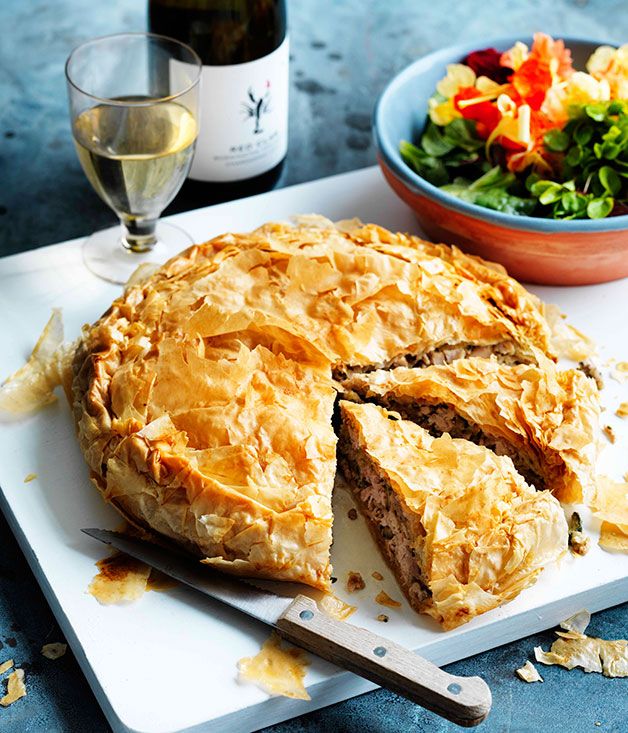
Line a 35 x 25cm (14 x 10 inch) buttered baking dish with 5 phyllo pastry sheets, each brushed with melted butter.   Sprinkle with dried breadcrumbs and carefully spoon in the filling, and level the surface with a spatula.  Tuck the cheese cubes evenly into the filling, fold the pastry over and lay 5 more buttered sheets on top.    Trim the pastry and tuck it neatly into the sides of the dish. Score the top layers of the pastry into portions.   Brush the pie once more with hot butter, sprinkle slightly with water and bake it in a moderate oven preheated to 190 C (375 F) for 40-45 minutes.  
Serve with a green salad.   


                                                             BACLAVA


One could prepare this baclava roll with more pastry sheets.


5 sheets of phyllo pastry
120 g (4 oz) hot butter

250 g (½ lb) unpeeled almonds, roasted
2 tbsp icing sugar

Light Syrup
250 ml (1 cup water)
130 ml (1 cup sugar)
Boil for 5 minutes


Grind the almonds and mix well with the icing sugar.

Brush a sheet of phyllo pastry lightly with hot butter and sprinkle, sparingly, with the almond/icing sugar mixture.  Place another sheet exactly on top of the first and repeat the same procedure, until all the pastry has been used. 

Roll like a jam roll, place it in a buttered baking dish and cut in thick slices with a very sharp knife.  Brush lavishly with sizzling butter and bake in an oven preheated to 180 C (350 F) for about 20 minutes or until crisp and golden.  Remove from oven, cool a little, then pour the hot syrup over.  Serve cold.


                                   KARYDOPITA ME GLASO CHOCOLATAS
                                        (Walnut Cake with Chocolate Glaze) 


This cake is very light and easy to prepare.

Cake:
180 g (6 oz) butter, at room temperature
180 g (6 oz) sugar
150 g (5 oz) self-raising flour
1 tsp baking powder
1 pinch of salt
5 medium-sized eggs, separated, whites whipped to stiff peaks with a pinch of salt
Vanilla
120 g (4 oz) walnuts, coarsely chopped

Glaze:
150 g (5 oz) dark chocolate chopped
150 ml (5 fl oz) cream
1 tsp honey

A few walnuts for garnish


Sift flour, baking powder and salt together.   Coat the walnuts with 2 tbsp of the flour mixture and reserve.

Preheat the oven to 180 C (350F).   Cream the butter and sugar, until light and fluffy.  Add the vanilla and the egg yolks, one at a time, beating well after each addition.  Sift in the flour and mix well.  Fold in two large spoonfuls of whipped egg-whites to soften the batter.  Stir in the walnuts, and then, gently, fold in the remaining whipped egg whites.

Pour into a buttered baking tin, lined with baking parchment, and bake for 45 minutes or until a skewer inserted in the middle of the cake comes out clean.  Remove the cake from the oven and reverse on a serving dish and put aside to cool.

Heat the cream and just before it reaches the boiling point pour over the chopped chocolate.   After two minutes, add the honey and stir until the chocolate is smooth and shiny.   Pour the warm chocolate over the cake to cover and garnish it, attractively, with halved walnuts.


(I wish to thank Wikipedia, the blog My Albanian Food, my beloved Mother and my dear friend Gustel Koenig. without whose valuable help this post would not have been written)


Preparing a Vase of Flowers By George Iakovides


For You Dear Reader - One of the Best by George Iacovides


Wednesday, 27 November 2019

GRIEF FEAR AND FURY AFTER THE EARTHQUAKES IN ALBANIA


Devastation After the Earthquakes' Fury 

I had promised myself that I would not write unpleasant or tragic news in this post.  But I reconsidered after a large earthquake measuring 6.4 on the Richter scale shook north-western Albania, unfortunately, leaving 41 people dead, over 648 injured and 51 still missing. The damages are very severe, there is no power, and it is feared, the aftershocks will flatten out the ruins that are still standing, possibly causing more victims.  


Unfortunately, the buildings in Albania were built in a slapdash fashion and not under anti-seismic specification laws, so they were susceptible to collapse with the faintest of tremors.  The Albanians, besides having a feeling of profound grief for losing their loved ones and fear for more and stronger earthquakes, are, also, extremely furious against their governments for not compelling them to use strict building regulations.  


Meanwhile, rescue workers from the neighbouring countries, the European Union and the USA, risking their lives, are desperately trying to save people that are trapped under the rubble. 


This brought back sad memories of the 1953 monster earthquake, measuring 7.2 on the Richet scale, in Cephalonia, Ithaki and Zakynthos, which totally flattened out the islands, leaving 600 dead and umpteen injured.  My parents and I were, then, on home leave, visiting our island, Cephalonia.  We survived this tragic event but it left our beloved Cephalonia and the other islands levelled to ruins. Some of our compatriots were in deep mourning and all were homeless, living in tents but dreaming constantly of building a beautiful, new Argostoli.  All three islanders were, then, greatly admired worldwide, for their resilience and courage.   


It took many years for the islands to be restored after this appalling disaster, but, somehow, the new buildings of Argostoli certainly don't resemble our distant but very clear memories of the magnificent constructions that were erected so many years ago, according to Venetian and neo-classic architecture.      


Argostoli, Cephalonia After the 1953 Monster Earthquake 


Cephalonia the Homeric Island of Culture and History


(I wish to thank ERT, BBC, FRANCE 24, CNN and the August 1953 international press for their valuable information and photographs, without which this post would not have been published)


Monday, 25 November 2019

FLOODS IN GREECE


On Monday the 25th November, thunderstorms swept through Greece causing heavy flooding and disruption to sea transport.   Unfortunately, the Coast Guard reported today that two men were killed after their moored vessel capsized in Antirio, western Greece.


Floods in Attica

Capsized Yacht Near Antirrio

The storm called Gyrionis, caused havoc across the country destroying roads and flooding buildings.   The damage is unaccountable and the police and the fire brigade received more than 64 calls to save people from their flooded homes in the area of Kinetta, near Athens.  The heavy downpour and debris from the hills blocked the Athens-Corinth highway and, also many cars were swept away by the fury of the waters.   In Katerini, in northern Greece, the roads resemble rivers.


Flooded Roads in Katerini


Finally, late in the night, thunderstorms with strong winds reached the Dodecanese.  The island of Leros is deluged by the downpour and, unfortunately, an invalid 75-year-old woman found tragic death in her flooded house in Rhodes.


Simi Island - Flash Floods - Rockslides - Disaster


Moreover, the Island of Thassos has been hit for a second time in November, by this terrible storm.


(I wish to thank ERT, STAR TV.gr, BBC, FRANCE 24, CNN and Kathimerini, Estia, The Guardian, The Times and the blog Greek Reporter for their valuable information, without which this post would not have been published.)


Wednesday, 20 November 2019

LATEST INTERNARIONAL NEWS


Recently, many important and serious events are taking place, worldwide, with which both the politicians and the public are considerably concerned.


The Russian Attack Against Ukraine

On Wednesday the 29th November, the fourth day of the public hearing examining whether  President Donald Trump’s actions, when he asked the Ukrainian president to investigate former vice president Joe Biden’s son is "impeachable conduct".  


The hearing began with testimony from the US Ambassador to the European Union, Gordon Sondland, who apparently was overheard, while on the phone, discussing the status of the “intervention” with Trump.  Sondland has already reconsidered "his closed-door testimony to confirm the central allegation of a quid pro quo".  According to Reuter’s Loren Elliot, Mr Sondland said that he was “adamantly opposed to any suspension of aid, as the Ukrainians needed those funds to fight against Russian aggression”.      


He went on to say that he had “tried diligently” to ask why the order was suspended but he never received a definite response.  The absence of any conclusive account for the interruption of aid would not occur, until a public statement from Ukraine “committing to the investigations of the 2016 elections", as Donald Trump's lawyer, Mr Giuliani,  had demanded.


Other government officials, such as Laura Cooper, Deputy Assistant Secretary for Defence, for Russian, Ukrainian and Eurasian Affairs, as well as David Hale, Under Secretary of State, were present at these discussions.  Also, the House Speaker, Nancy Pelosi invited Donald Trump to appear at the hearings in order to answer questions, even in writing, if he so wished.


According to Reuters, President Trump on Friday, the 22nd November, accused a witness in the "Democratic-led impeachment inquiry of lying, and offered an explanation for his controversial use of his personal lawyer, Rudi Giuliani, on the Ukrain policy, saying that Giuliani's crime-fighting abilities were needed to deal with a corrupt country." Trump, apparently, made this remark on the day after the fifth and final day of public hearings in the House of Representatives, an inquiry that threatens his presidency.   


Fighting the Honk Kong Protestors

Beijing has warned Washington of “strong countermeasures”, if Trump accepts legislation supporting the Hong Kong protesters. 


China demanded President Donald Trump to veto the legislation  aimed at backing  Hong Kong’s pro-democracy protest movements, warning it will reciprocate if  the “congress-backed bills” become law.


On Tuesday, the Chinese foreign ministry spokesman said Hong Kong Human Rights and Democracy Act eroded Beijing’s interest in the semi-autonomous territory, which has been rocked by many months of anti-government demonstrations. 


The Duke Pictured with Virginia Giuffre 

Prince Andrew, the Duke of York says that he is “stepping back from his royal duties”, because the Jeffrey Epstein scandal has become a “major disruption” to the Royal Family.


The duke has faced a growing reaction following the BBC interview about his friendship with the American financier.  For several months he has been facing questions over his ties with Epstein, who committed suicide last August, while "awaiting trial on sex trafficking charges".


Virginia Giuffre, one of Epstein’s accusers, claimed that she was only seventeen when she was forced to have sex with Prince Andrew three times.   The duke has strongly denied all the accusations.   His latest action, described by the Palace as “a personal decision” was taken after a meeting with the Queen and Prince Charles.


Lewis 


Mrs Toni Doherty with Lewis

A badly burned Koala bear was saved by the heroic motorist and grandmother, Mrs Toni Doherty, who rescued him from catastrophic bush fires in New South Wales, Australia.  He is now called Lewis and is successfully convalescing at the Port Macquarie Koala Hospital! 


According to the Organization for Economic Cooperation and Development, in its latest economic report, said it expected Greece to "achieve a target of a 3.5 % Gross Domestic Project (GDP) primary surplus next year."  It also noted that "the planned expansionary fiscal policy would give the Greek economy a greater than expected boost.  It would apparently expand by 2% over the next few years." However, the export growth of the country will be moderated by the sluggish external demand. 


Lesvos, Chios, Samos, Leros and Simi Have the Most  Demanding Migration Problem
Flimsy boats packed with migrants and refugees arrive, daily on our islands in the Aegean Sea.  Some of these unfortunate people, fleeing from war, seek a better life for their families in the European Union, while others, some of whom are illegal, are seeking jobs. This, obviously, is a very difficult situation for Greece.


In 2016, the European Union and Turkey agreed on a refugee deal.  An important condition of the deal being that immigrants arriving on the Greek islands, would be returned to Turkey, except if they applied and received asylum in Greece.


As I had written in my post REFUGEES AND IMMIGRANTS “According to The Times, many of the 50 refugee camps in Greece are, unfortunately, in a tragic condition, dirty, overcrowded, full of sick people and unaccompanied minors.” 


 The UNHCR has issued a report called The Mediterranean Situation, which states that during 2018, 32.494 refugees and immigrants had arrived from Turkey to Greece, while the number of arrivals until November 2019, is already 62.190, almost double than the previous year.  


The Greek Government has announced a catalogue of measures to deal with the rising migration flows, according to Al Jazeera, including the deportation of 10.000 people by the end of 2020 and relocating thousands to the mainland from the overcrowded island camps.   They also announced an increased number of naval patrols in the Aegean, and producing "closed centres" for migrants who have been refused asylum, until they return to Turkey.

 
 Also, as Greece is just starting to recover from a period of deep economic recession, it cannot offer hospitality to so many uninvited guests.  Unfortunately, our European Union partners refuse to offer shelter to these unfortunate people.  Obviously, people fleeing from the wrath of war should be helped but can everybody be aided by Greece alone?  Can we endure and afford it?  So, EU partners let us all share offering hospitality to these unfortunate people, and please don’t criticise us, unjustly, because we simply cannot bear this unbearable burden alone.


Refugees Arriving in Greece, Helped by Volunteers and a Red Cross Doctor 


A state of emergency has been declared for the island of Thassos and the Municipality of Olympiada in Halkidiki, after torrential rains hit northern Greece.


The rainfalls caused enormous damages on the island of Thassos where people’s lives were at risk.  The mainstream at Potamia overflowed and the water ran uncontrolled, sweeping away whatever was in its way.  A biblical catastrophe. The residents were trapped in their houses and could only be evacuated and brought to safety by the brave men of the fire brigade.  Roads, houses, hotels and businesses remained flooded on Saturday, as the municipality workers and the firefighters are racing against time, as another bad weather front is expected on Sunday evening.


The Greek army has also helped, digging vehicles out of the mud to assist the local authorities.   Several areas are without electricity and a new barometric low is forecasted to hit the area as well.


(I wish to thank ERT, SKY-TV, Reuters, Al Jazeera, France 24, CNN, BBC, Estia, Kathimerini, The Times and The Guardian, without whose valuable help, this post would not have been published.)


Floods in Northern Greece


Trying to Save a Car


Monday, 18 November 2019

THE 46TH ANIVERSARY OF THE STUDENT UPRISING AGAINST THE MILITARY DICTATORSHIP


Lest We Forget

Yesterday we commemorated the 46th anniversary of the student uprising against the military junta which harassed Greece for seven horrible years, from 1967 to 1974.  The uprising actually began on the 14th November 1973 and escalated to a fully-fledged anti-junta revolt, ending, unfortunately, in bloodshed, during the early morning hours of the 17th November.


Since 1967, Greece had been under a brutal military dictatorship, which had abolished political parties and civil rights and had imprisoned, tortured and even killed people with different political ideologies.  They had, also, banned student elections in all the universities of the land, so numerous Greeks were fuming against the instigators of the junta, who had imposed these formidably cruel measures, particularly the students.


On November the 14th 1973, students started demonstrating against the dictatorship at the Athens Polytechnic and at the campuses of Thessaloniki and Patras, which culminated into a robust student rebellion.   They were joined by other citizens, from all walks of life, from members of the working class to those of the intellectual elite, who were all furious with the military regime.
   

On the 16th November, students and other fellow demonstrators attempted to march to Syntagma Square but were violently stopped by the police.   So, the students gathered at the Polytechnic and started preparing for a siege.  They collected food and medicaments and they built barricades.  They, also, broadcasted on a clandestine radio station, proclaiming that the time had arrived to overthrow the detestable junta, inviting their compatriots to join them in their effort.  Moreover, they painted anti-junta sketches on buildings and busses thus spreading the anti-dictatorship message throughout the city.  Simultaneously, exactly the same was happening, all over Greece.


At 2 am of the 17th of November 1973 tanks were ordered to crush the student rebellion at the Polytechnic school.  At 2.15 a group of students came out of the building to negotiate a surrender, asking for a half an hour period in order to evacuate the campus.   But, unfortunately, the junta officers in charge ordered a tank to crash through the gates of the polytechnic and the policemen and soldiers stormed through the building, beating students with clubs and arresting them.  Apparently, thirty-four demonstrators were killed, many were injured and almost a thousand were arrested. This was how the Polytechnic revolt ended, with blood and fury... and then martial law was imposed.  


A dark, bloody period of Greek history which we must commemorate each year, lest we forget.


(I wish to thank ERT, SKT TVgr, The Greek Reporter, BBC, France 24, CNN for the valuable information, without which this post would not have been published.)