Thursday, 30 October 2014

AMPHIPOLIS


In early August 2014 the international community was informed that the archaeological dig in Casta, Amphipolis, N. Greece, unearthed two very beautiful sculptures depicting two sphinxes made out of Thassos marble.    They have been standing there for over twenty three centuries, silent sentries of a tomb of a very significant person.

  
Since then, two caryatids have been found, that support the entablature of the second chamber of the tomb.  These elegant female figures, 2.27 metres in height, standing on pedestals, are absolute masterpieces, from their sensual faces to their draped chitones, to their beautifully chiseled toes.


On the 12th of October, Greek archaeologists discovered a large floor mosaic depicting Pluto’s abduction of Persephone.  It has beauty and motion  and according to the Greek Ministry of Culture it is “stunning, superbly rich in colour and artistic detail.”

Renowned archaeologists and art historians presume that the tomb might be a cenotaph of a very influential person, even Alexander the Great.   But, there will be no end to our tormented curiosity, no answer to the enigma until the excavations discover the truth.

We are, all, so very proud of these admirable, hardworking experts, who, with sources from ancient historians and local tales, try to find the locations and, then, the means to dig and bring to light these hidden treasures.  We wish to thank them so very much. 


For ancient Greeks frugality was a virtue.   They ate grains, pulses, vegetables, fish, garon (a fish sauce), meat and poultry on rare occasions, cheese, nuts, olive oil, olives, fresh and dried fruit.   The sweetening agents were honey, dried figs and a syrup prepared with grapes (petimezi?).  They drank water and of course wine.  It was considered barbaric for adults to consume milk.

As there are no recipes of ancient Greek food, I will give you a few traditional recipes using the ingredients mentioned above.


                                                           TRAHANA SOUP


Trahana is a Greek pasta made by the Greek pasta industry and small cottage industries all over the country.   We first tasted this delicious traditional soup, on a very cold day in Arahova, a ski resort.

Pasta:
1 kg (2 lb) strong flour
1 egg
250 ml (1 cup) milk
200 g (1 tub) yogurt
½ tbsp salt
Water

Soup:
1.750 litre (7 cups) tasty meat, chicken or vegetable stock or water
250 ml (1 cup) tomato juice
2 tbsp olive oil
(Salt if using water)
1 cup trahana pasta
1/8 tsp Cayenne pepper
125 ml (½ cup) hot milk
Salt if necessary and freshly ground black pepper

Crumbled feta, or grated kephalotyri or pecorino, for serving

If you want to make the pasta, place the flour and salt in a large bowl, and stir in the egg, milk, yogurt, and enough water to make a stiff dough. Shape into small balls, the size of walnuts and let them dry for 2-3 days. Then divide them and shape into smaller balls the size of hazelnuts and allow them dry for a few days more.   Then either sieve the dough, pressing it through a special sieve, or rub it with the palm of your hands until it is as fine as oatmeal.  Dry again and store in jars.  It will keep for many months.

 For the soup, boil the stock or water for five minutes, with the tomato juice, olive oil and salt (if using water).  Sprinkle the trahana over and stir until it comes to the boil.  Lower the heat, add the Cayenne pepper and simmer for 15-20 minutes until the pasta is soft, stirring often to prevent sticking.  Just before serving pour in the hot milk and stir.  Taste and sprinkle with salt (if necessary) and freshly ground black pepper.    Serve the soup, steaming hot, with a bowl of crumbled feta or grated cheese on the side.


                                                                CHEESE PIE

                                                                     Tyropita


 You could, use 1 cup of bechamel sauce instead of the yogurt.

Pastry:
150 g (5 oz) whole meal flour
150 g (5 oz) plain flour
Pinch of salt
¼ tsp mustard powder
1 egg
1-2 tbsp water

2 tbsp dried breadcrumbs for sprinkling over the pastry before adding the filling

 Filling
500 g (1 lb) feta cheese, soaked in water for 5-10 minutes if salty
250 g (½ lb) anthotyro or ricotta cheese
2-3 tbsp kephalotyri or Parmesan or Cheddar, grated
1 large onion, finely grated
4 eggs
200 g (1 small tub) strained Greek yogurt
Salt if necessary, nutmeg and freshly ground black pepper

First prepare the pastry.  Blend the two flours with the mustard powder and salt.  Add the butter and pulse until the mixture resembles breadcrumbs.  Add the egg and very little water until the dough forms a ball around the hook. .. Cover and refrigerate for ½ hour at least.

In a large bowl, crumble the feta and anthotyro and stir in the grated cheese and onion.    Beat the eggs with the yogurt, nutmeg and freshly ground black pepper, add to the cheese mixture and stir until well combined. Taste for seasoning and add more salt, pepper and nutmeg, if necessary.

Preheat the oven to 180 C (350 F).   Cut the pastry in half and roll out two thin pastry sheets.    Line a buttered baking tin with one of the sheets and sprinkle evenly with the dried bread crumbs.   Spoon the filling carefully over, cover with the remaining pastry and  join the two sheets attractively together.   Score the top of the pie and bake for about 45 minutes to 1 hour.

(Serves 8-10)


                                                A SALAD FROM THESSALONIKI


 I presume that our ancient forefathers didn't cultivate red cabbage.   Also, peppers were unknown in Europe before the end of the 15th century, so all the ingredients could not be found when the Amphipolis tomb was erected.  To honour the region, I'm giving you this recipe for a colourful salad from N Greece..      

½ kg (1 lb) white cabbage, finely shredded
125 g (4 oz) red cabbage, finely shredded
Ice cold water
62.5 ml (¼ cup) white wine vinegar

2 celery stalks, trimmed and finely sliced
3 carrots, coarsely grated
½ a yellow pepper cut into julienne strips
½ a red pepper cut into julienne strips
2 spring onions, finely chopped or 8 chive blades, snipped 
1-2 sweet gherkins finely chopped
½ cup parsley, finely chopped
½ tsp salt

Dressing:
2 tbsp good wine vinegar
6 tbsp extra virgin olive oil
½ tsp Dijon mustard
Juice and zest of an orange
1 tbsp honey
Salt and pepper to taste
Whisk all ingredients until the sauce thickens.

Season the red cabbage with half a teaspoon of salt, mix well and refrigerate for about an hour.    Then rinse thoroughly with cold water.

Fill half a large bowl with ice-cold water and the vinegar, add the red cabbage, cover and refrigerate for half an hour, at least.   Then strain, dry and arrange it in a cold salad bowl.  Add the remaining ingredients, the salad dressing, toss thoroughly and sprinkle with chopped parsley.

 (Serves 6) 


                                                             FRUIT SALAD


This fruit salad could have easily been prepared in Greece, in the fourth century B.C.

1 melon, peeled, seeded and cubed
2 cups seedless grapes
4 pears, peeled cored and, cubed

The juice and grated rind of 1 orange mixed with
The juice and rind of ½ a lemon and
2 tbsp honey

Garnish:
2 figs peeled and cut in four,
½ cup walnuts coarsely chopped
2 sprigs of mint

Mix the first three ingredients together, sprinkle with orange/lemon/honey mixture and lightly toss together.   Arrange in an iced bowl and garnish with figs, walnuts and sprigs of mint.     


Monday, 20 October 2014

LITTLE SOPHIA


                                A baby is cuddles
                                And tickles on toes
                                The sweet scent of powder
                                A kiss on the nose ................


On the 16th October 2014, in Copenhagen, our grandson Alex and his lovely wife Tina had their second daughter, Sophia, a tiny, loving sister for two-year-old Janna.    Our very best wishes and deep affection to the jubilant parents, the “big” sister and the extremely proud grandparents!


                               Tina and Alex:                              
                               
                               They are little bits of sunshine
                               They are smiles to light your days
                               They will steal your heart and keep it
                               In their warm, endearing ways
                               They’re your precious little daughters
                               With a sweetness from above
                               They will fill your years with laughter
                               And your lives, with lots of love.


Let us celebrate!


                                                     CHOCOLATE DESSERT


                                          Little Janna loves this dessert


You can prepare this delicious dessert, drenched with a chocolate cream sauce, garnished with strawberries or any other fruit of your choice.   You can, also serve it as a cake, dusted with icing sugar.

200 g (6 2/3 oz) good quality dark chocolate cut in small pieces
200 g (6 2/3 oz) butter
300 g sugar, halved
6 eggs, separated, whites stiffly beaten with a pinch of salt and half the amount
                                                                       of sugar, a teaspoon at a time 
1 scant tsp vanilla
100 g (3 1/3 oz)) self-raising flour mixed with
1 tsp baking powder


Chocolate Cream Sauce:
100 g (about 3 1/3 oz) dark chocolate, cut into small pieces
100 g (about 3 1/3 oz) cream
1 tsp honey


Melt the chocolate and butter over simmering water and stir until thoroughly mixed.   Remove from the heat and set aside to cool.

Beat the egg yolks with the remaining sugar and vanilla until light and fluffy, pour in the cool chocolate/butter mixture and stir.   Sift in the flour and baking powder, and stir the batter lightly, until well combined.  Carefully fold in the whipped egg whites and pour in a buttered cake tin, lined with baking parchment.
  
 Bake in an oven preheated to 180 C (350 F) for about 40-50 minutes, or until a skewer inserted in the middle of the cake, comes out clean.  Remove from the oven.  With a flexible knife detach the sides of the cake from the baking tin.   Reverse the cake on a dish, discarding the baking parchment, and set it aside to cool.

For the sauce, place the chocolate pieces in a bowl.  Heat the cream just below boiling point and pour over the chocolate, add the honey and stir very well together until the sauce is cold, smooth and glossy.
     
Place the cake on a platter, spread the chocolate sauce evenly over the top, and garnish, either, with fresh strawberries dipped in melted chocolate or marrons deguises, or chocolate curls or nuts.

(8-10 servings)


                                                   CHOCOLATE CUP-CAKES


Cup cakes are trendy and very popular with both children and parents alike. 


210 g (7 oz) self-raising flour, sifted with
1 tsp baking powder
33 g (1/3 cup) cocoa powder
Pinch of salt
210 g (7 oz) icing sugar

100 g (½ cup – 1 tbsp) butter, at room temperature

3 eggs
150 ml (an ample ½ cup) milk
Vanilla
1 tbsp yogurt

Icing:
100 g (1 ½ cup – 1 tbsp) butter
180 g (6 oz) icing sugar
25 g (2 tbsp) cocoa
Vanilla
A suspicion of salt

Preheat oven to 180 C (350 F).

Place the sifted flour/cocoa/sugar mixture in a large bowl, add the butter and rub gently with your fingers until the mixture resembles crumbs.

In another bowl beat the eggs, milk, vanilla and yogurt until well combined.  Gently mix the liquids into the dry ingredients and stir well, until the batter is smooth and shiny.

Line a 12 socket cup-cake with paper cups.   Fill each paper cup half full with the cake batter, bake for 20-25 minutes until a skewer inserted into the middle of the cakes comes out clean.   Remove from the oven and allow to cool.   Then remove the cupcakes, in their paper cups, from the tin.

Meanwhile prepare the icing.   Whip the butter with the icing sugar, cocoa salt and vanilla until smooth and glossy, and garnish the cupcakes.

You could, alternatively, add about 150 g (5 oz) chopped white chocolate into the batter before baking.  Serve without icing.        


Wednesday, 8 October 2014

 A FEW COMFORTING FIRST DISHES


Unfortunately the heavy air strikes against the ISIS extremists have failed to halt the advance of this murderous group.   They have taken control of the industrial zone of the key strategic city of Kobani, on the Syrian -Turkish border.   Right now, the Jihadists are engaging into fierce street to street fighting with the outnumbered, underequipped, but very brave Kurdish defenders.   The Kurds are fighting alone, without the help promised by Turkey, who seems reluctant to attack.   Naturally, there is a large flow of civilians who are crossing the border, in search of safety.

Due to the prevalent chaos on the Syrian -Turkish border, there is a suspicion that ISIS might send terrorists into Europe, disguised as refugees, who, provided with fake passports, could strike horrific attacks all over the continent.

In W. Africa, the number of the deceased, due to the Ebola epidemic, has grown to 3400.  In Madrid, a nurse, who treated two victims of Ebola, has been tested positive for this very dangerous disease. Four more people, including the nurse’s husband have been admitted into hospital for observation.   The World Health Organization said that “Europe would certainly see more cases”.


We certainly need tasty food to comfort us during these very difficult times.


                                                          COURGETTE BAKE


This is an easy and delicious first dish.

2 cups grated courgette
4 rashes bacon, cut in small pieces, sautéed and drained on kitchen paper
1 large tomato, skinned, deseeded and diced
½ cup self raising flour
1 large onion, grated
4-5 eggs
Salt and pepper
¼ tsp or less Cayenne pepper
150 g (5 oz) cubed feta

1 cup grated bland kefalotyri, cheddar or Parmesan

An oven-proof dish, greased with:
A knob of butter and sprinkled with
Dried bread crumbs


Preheat the oven to 180C (350 F).

In large bowl mix the first eight ingredients well together.   Fold in the feta gently and spoon the mixture into the prepared dish.   Sprinkle evenly with grated cheese and bake  for 45-50 minutes, or until a knife inserted in the middle of the bake, comes out clean.   Serve with a green salad, crusty warm bread and a glass of wine.


                             SAVOURY CARROT CAKE WITH CHEESE AND HERBS


Try this interesting recipe.

500 g (1 lb) carrots, coarsely grated
3 heaped tbsp soft butter
2 spring onions, finely chopped
1 tsp coriander seeds, crushed and sieved
4 eggs, separated, egg whites whipped into stiff peaks, with a pinch of salt
3 tbsp self-raising flour
1 tbsp chopped parsley
Salt and pepper

Filling:
210 g (7 oz) anthotyro crumbled, or ricotta cheese,
1 tsp chopped dill,
3 spring onions, finely chopped,
3 tbsp chopped parsley,
1 tsp chopped fresh marjoram,
1 tsp chopped fresh thyme
250 ml (1 cup) or low fat cream,
Salt and pepper,
3 tbsp San Mihalis or Parmesan, grated.


Saute the carrots, spring onions and coriander in butter for about five minutes and set aside to cool, in a bowl. 

Add the egg yolks, flour, parsley, salt and pepper to the carrots, and mix well.  Gently fold in the egg whites and spread the batter evenly in two 23 cm (9 in) diameter cake tins, lined with baking parchment.  

Bake in a moderate oven, preheated 180 C (350 F) for about 20 minutes.  When ready turn out and set aside to cool.

In the meantime make the filling.  Combine the anthotyro, herbs, spring onions, cream, salt and pepper and two tbsp of the grated cheese and mix well together.   Taste for seasoning and adjust with salt and pepper if necessary and add a little more cream if the mixture seems dry.    The filling should have the consistency of cream cheese. Taste and add more salt pepper or herbs , if necessary.

Finally sandwich the two carrots cakes with the filling in between.  Reserve a little filling to spread over the top and sprinkle with the remaining grated cheese and freshly milled pepper     Serve on salad leaves, and garnish with marjoram, parsley and thyme sprigs


                                                            COURGETTE TART


This is a delectable savoury tart.

Pastry:
240 g (8 oz) self raising flour mixed with
½ tsp salt

120 g (4 oz) soft butter
1 egg yolk
Enough thick Greek yogurt to obtain a soft dough

1½ tbsp fine dried breadcrumbs and
2 tbsp grated cheese for sprinkling over the pastry shell

Filling:
1 tbsp olive oil
600 g (1 lb 3 oz) courgettes, thickly grated
3 medium carrots, grated
1 medium onion, grated
2 spring onions trimmed and finely sliced
2 tender celery stalks, trimmed and finely sliced
500 ml (2 cups) low fat cream, 

For the top
90 g (3 oz) bland kasseri or Emmenthal, grated
90 g (3 oz) Naxos graviera or Gouda, grated
90 g (3 oz)  Parmesan grated
Freshly grated white pepper

For the pastry rub the butter into the flour until it looks like fine bread crumbs. Add the egg yolk and enough yogurt to obtain a soft dough.  Wrap in cling film and let it rest for 30 minutes.

Meanwhile, prepare the filling. Sauté the vegetables in olive oil, add salt and pepper, lower the heat and let them sweat gently until they resemble a puree.  Add the cream and simmer until most of the liquid has evaporated and the vegetables are thoroughly cooked and set aside to cool. 

Preheat the oven to180 C (350 F).   Roll out the dough between two pieces of baking parchment and line a  buttered 25 cm /10 inch round ovenproof dish.   Prick the pastry all over with a fork and sprinkle with bread crumbs and cheese.  Carefully spoon in the filling, and level the surface.  Mix the three cheeses with the freshly ground white pepper and sprinkle evenly on top.  Pinch the dough around the edge into a pretty shape and bake for about 40 minutes or more, until the pastry is crisp and filling golden and bubbly.


                                                             QUICHE LORRAINE


Ages ago, when I was newly married, I had read this recipe in Vogue magazine.   I promptly prepared it and, to my suprise and joy, my husband and our friends found the crust exceptionally crisp and custard creamy and luscious.

Pastry:
240 g (8 oz) plain flour
1 tsp salt
120 g (4 oz) iced butter, cubed
1 egg
2 tsp iced water

Filling:
8 rashers smoked bacon, cut in pieces, sautéed and drained on kitchen paper
90 g (3 oz) grated Gruyere or bland Cheddar

2 whole eggs
2 egg yolks
275 ml (1 cup + 2 tbsp) double cream
Salt and white pepper to taste

A little iced butter for the top


Mix the flour with salt and rub with butter until it looks like fine breadcrumbs.   Add the egg and mix well together.  If the dough crumbles, add a little iced water until it comes together.  Shape into a ball and flatten it, then cover with cling film and refrigerate.   

Roll out the dough, between two pieces of baking parchment, to form a circle.  Line a buttered 20 cm (8 inch) flan tin with the pastry, gently press it into the bottom and the sides of the tin and chill for one hour. Prick the tart all over with a fork.

Preheat the oven to 180 C (350 F).   Cover the pastry with tin foil, to prevent it from puffing and bake for 15 minutes in the centre of the oven.   Discard the foil, bake for 10 minutes more and remove from the oven to cool.

Sprinkle the grated cheese over the cold pastry shell and cover with bacon.   Beat the whole eggs, egg yolks, cream and the seasoning and pour over the bacon and cheese.   Dot the tart with butter and bake in the top of the oven for 20 minutes until puffed and golden.   Serve hot or warm.

.


                               SPINACH, PRAWN AND MUSHROOM AU GRATIN


My friend Michele Nemtzoglou made this lovely dish for our bridge group.  I replaced chicken by prawns and added feta cheese to give it a Greek touch.   It is, really, a full meal, but if you bake it in appropriate, individual dishes, it’s a starter.

1 kg (2 lb) frozen spinach leaves, chopped

1 tbsp olive oil
1 tbsp butter
1 medium onion, grated
1 large leak, white part only, slit in four lengthwise, thoroughly washed and chopped
2 tbsp dill
Salt and pepper

1½ kg (3 lbs) prawns, shelled, intestine removed (about 1 kg / 2 lb, when shelled)
2 sprig rosemary
1 tbsp olive oil
A little salt
Freshly ground black pepper

500 g (1 lb) button mushrooms, cut in quarters
1 garlic clove, sliced
A little olive oil
Salt and pepper

150 g (5 oz) feta cheese (if salty soaked), finely sliced

White sauce:
500 ml (2 cups) hot milk
250 ml (1 cup) single cream
A few gratings of nutmeg
3-4 heaped tbsp cornflour
1 small bay leaf
1½ cup grated cheese, Cretan Graviera or Gruyere or a bland Cheddar

3 eggs, separated, whites whipped to the soft peak stage with a pinch of salt
Yolks mixed with
2 heaped tbsp yogurt


A knob of butter for greasing the baking dish/dishes
2 tbsp dried breadcrumbs for sprinkling over


Cook the onion and leeks in olive oil, with a pinch of salt and a little water, until soft.  Stir in the butter, spinach, pepper and simmer gently until cooked and dry. Add the dill and mix until well combined.

Sauté the prawns, on both sides, with the rosemary, in very little olive oil, until they just change colour.  Sprinkle with a little salt and pepper.  Discard the rosemary, remove for the heat and set aside for further use.

Also cook the mushrooms and garlic in olive oil, tossing frequently, until no cooking liquid is visible. Season with a little salt and pepper and set aside.

Prepare the sauce.  Place the milk and cream in a saucepan, grate in a little nutmeg, add the bay leaf, and stir in the cornflour.  Bring slowly to the boil, and simmer, stirring constantly with a wooden spoon, until the sauce bubbles and thickens. It should, now, coat the back of the wooden spoon.  This should take 12-15 minutes.  Remove from the heat to cool a little, discard the bay leaf, and stir in the cheese.   Add a tbsp or two of the hot sauce into the egg yolk/yogurt mixture, stirring quickly to prevent the eggs from scrambling, then add it into the remaining sauce and mix well to combine.   Finally fold in the whipped egg whites, mixing gently, until no trace of white is visible.   Taste the sauce for seasoning and add salt, pepper and nutmeg, if necessary.

Preheat the oven to 180 C (350 F).

To assemble the dish, fold 1 cup white sauce, or more, into the spinach and stir well to combine. Taste once more to check the seasoning and adjust if necessary.   Spoon the spinach, carefully, into the prepared baking dish/dishes and add a layer of prawns and mushrooms, pushing them, slightly, to partly cover.   Then top with slithers of feta cheese and mask, evenly, with the remaining sauce.   Bake for 45 minutes, or until puffed and golden.  Kali orexi!


                                              MULTICOLOURED PEPPER TART


I have known Maria Korassides since she was a child, because her mother was a dear friend of mine.   Maria told me that she, recently, made a lovely pepper pie with phyllo pastry and thus inspired me into preparing this tasty and colouful tart.

Pastry:
250 g (½ lb) plain flour
1 tsp salt
125 g (¼ lb) iced butter, diced
1 large egg
1-2 tsp iced water

A knob of butter for the baking dish

1 cup coarsely grated kasseri or Cheddar

Filling:
500 kg (1 lb) multicoloured + Florina peppers and kerato peppers
1 tbsp olive
Salt and freshly ground pepper

½ cup finely grated Parmesan
250 ml (1 cup) milk at room temperature
250 ml (1 cup) thick cream, at room temperature
4-5 medium eggs
Salt, pepper to taste

For the pastry, mix the salt and flour and rub with butter, until it looks like bread crumbs.    Add the egg, mix the dough with you hands until it gathers together.   If it crumbles, add a little iced water.   Shape the dough into a ball, flatten it out, wrap with cling film and refrigerate for half an hour, at least.

 Roll out the dough, between two pieces of baking parchment, to form a circle.  Line a 30 cm (12 inches) buttered tart dish with the pastry, gently pressing it into the bottom and around the sides of the dish, and trimming off the excess.  Chill for one hour.

Preheat the oven to 180 C / 350 F.   Remove the tart from the fridge and prick it all over with a fork.     Cover the bottom of the pastry with tin foil and press it gently into the edges to support the sides, and bake for 12 minutes.   Discard the foil, prick the tart all over with a fork, and bake for 10 minutes more.   Remove from the oven to cool.

Meanwhile, slice the peppers and halve or quarter each slice.   Sauté the peppers in olive oil until limp, and sprinkle with salt and freshly ground black pepper.  Remove from the stove to cool.

Sprinkle the tart shell with one cup grated kasseri or cheddar and arrange the peppers on top.   Sprinkle with Parmesan.  Whip the eggs with the milk and cream and pour over the peppers.   Bake for 35-40 minutes or until evenly puffed and golden.   Serve hot or warm, with a salad of your choice.


Wednesday, 24 September 2014

RUSKS - Paximadia


In ancient Greece, paximadia were called “Dispyros Artos”, which is Greek for "double-baked" bread.     This was, and still is, a method of preserving bread for a long period, and before refrigeration, rusks were indispensible to travelers during their long, tedious journeys over land and sea.   Originally they were made out of barley and were so hard, that they had to be soaked thoroughly before eating

Today Greek bread manufacturers produce the most delicious rusks.  Also, bakeries, all over Greece, are full of traditional and contemporary paximadia of all shapes and sizes, that are prepared with a combination of various flours, their taste flavoured with nuts, cheese, herbs, spices, cocoa, chocolate and dried fruit.


Here are a few recipes for both sweet and savoury paximadia.


                                                    CRETAN BARLEY RUSKS


                                                       A Cretan appetizer


This is our version of Cretan Barley Rusks.  You can also shape the dough into doughnut shapes, slice in half, lengthwise, bake and dry

250 g (½ lb) whole meal barley flour
250 g (½ lb) plain flour
30 g (1 oz) fresh yeast or
9 g (1 tbsp) dried yeast
1 tbsp honey dissolved in 2 tbsp warm water
More warm water, if necessary
1 tsp salt
3 tbsp olive oil

Garnish:
Tomato, seeded and chopped
Olive oil.
Vinegar
Salt and pepper
Fresh thyme
A few capers
Olives
Feta cheese, crumbled


Place the two flours and the dry yeast in a food processor and pulse to combine.   Add the diluted honey, olive oil, salt and a little more warm water, very gradually.  Blend, until the dough forms a ball around the hook.

Remove the dough from the food processor, place on a work surface, sprinkled with plain flour.    Knead for 5 minutes, place in a bowl, brush with olive oil cover and let the dough prove for 40 minutes or until it doubles in bulk.   Punch the dough down, knead it for 1 minute and shape into two equal cylinders and arrange them on a baking tin, lined with baking parchment.   Cover and let rise for 15-20 minutes more.

Meanwhile, preheat the oven to 180 C (350 F).   Brush the dough cylinders with olive oil and bake for 40-45.  Remove from the oven and cool.   Slice the bread with a serrated knife,, arrange the slices on the baking tin, and dry in a very low oven for 15-20 minutes, or until hard.  Turn off the heat in the oven, let the rusks, cool in the oven and store in tin boxes.

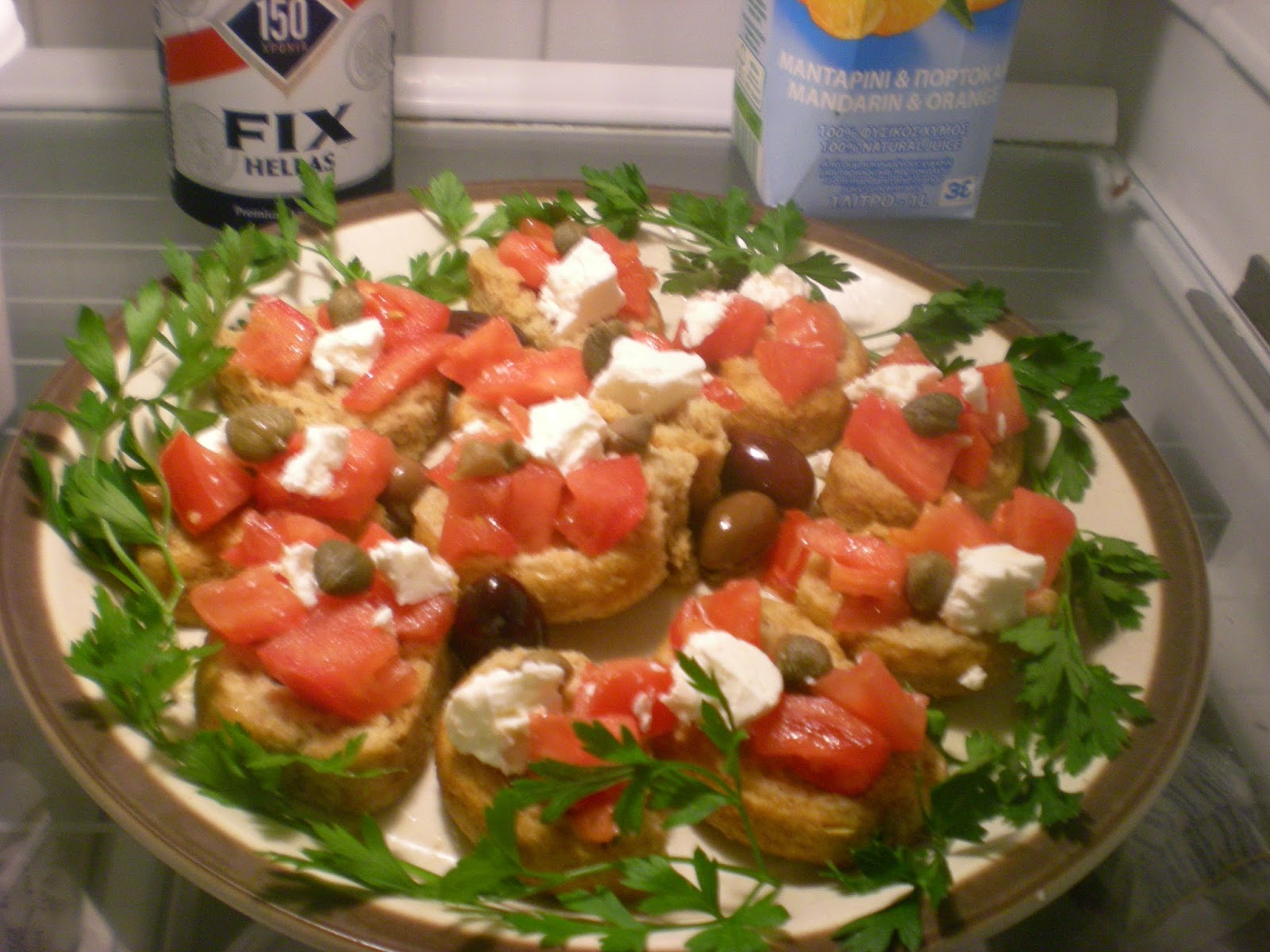
Serve the barley rusks, they way they do in Crete.  Soak slightly in water, drizzle with vinegar and olive oil, sprinkle with salt and thyme.  Cover the rusks with a spoonful of chopped tomato, capers, sliced olives and feta cheese.  Delicious!


                           RUSKS WITH OLIVE OIL AND HERBS FROM KYTHERA


                                            Slicing  before double-baking .......


This is another traditional recipe for paximadia that is very popular throughout Greece.

500 g (1 lb) plain or whole-meal flour 
1 tbsp dried yeast
1 tsp caster sugar
1 tbsp dried thyme
½ tbsp dried oregano
125 g (½  cup) olive oil
250 ml (1 cups) tepid water
1 tsp or more salt

Combine the flour, yeast, sugar and the herbs, in a large bowl and mix well together.   Make a well in the centre of the flour and pour in the olive oil.   Rub the olive oil in the flour with your hands until they become like fine breadcrumbs.  Add the water and salt and knead until the dough is smooth but rather hard.    Brush with olive oil, cover with cling film and a small blanket, and put aside, in a warm place to prove.   After 40 minutes to 1 hour it should be doubled in bulk.   Punch the dough, place on a floured surface and knead for 10 minutes more.   Shape the dough into two cylinders, place in a tin lined with baking parchment, cover and let them rise for ½ hour.

Bake the dough in an oven, preheated to 180 C (350 F) for 40 – 50 minutes.  Remove the bread from the oven and allow it to cool.   Cut it into 2.5 cm (1 inch) slices, and arrange them into the baking tin and dry in a low oven 150 C (300 F)  for 20-30 minutes more until dry and hard.  Store in a tin.


                                                 Rusks ready to eat


                                  BREAD WITH ONIONS, OLIVES AND FETA


                                         Rusks with Feta and thyme


This is a lovely recipe for bread that keeps fresh for 2-3 days.  Try it also with celeriac or carrots instead of onions.  Also only with  Feta and thyme.  The best olives to use are the ones stuffed with sun dried tomatoes or pimentos.  This bread that can be successfully dried in a slow oven


500 g (1 lb) flour
8-10 g (1 tbsp) dried yeast
½ tsp salt
2 medium onions, chopped
125 g (4 oz) or more feta, crumbled
1 tsp honey, diluted in
250 ml (1 cup) tepid water
1 cup stuffed olives, sliced

In a large, warmed bowl mix the flour with the dried yeast.  Then add the onions, salt and half the amount of cheese and mix well.   Add the water and honey mixture and knead vigorously for 8-10 minutes until the dough becomes elastic but remains soft.  Place the dough in a clean, warmed mixing bowl, cover the whole bowl with a plastic bag, tea-towels and a small blanket and let rise, free from draughts, until doubled in bulk  (about 1 ½ hours).

Knead the dough, again, add the olives and the remaining cheese.  Shape 2 loaves and leave to prove, on an oiled baking tin, for about half an hour, or until doubled in bulk.  Slash the loves and brush with olive oil.    Bake in a hot oven, preheated to 200 C (400 F) for 40 minutes, until golden and crisp. 

Slice the bread, arrange the slices in a baking tin and dry in a very slow oven. Turn and let cool in the oven.   Remove from the oven and store in tins.   


                                                 A BASIC LOAF OF BREAD


                              Rusks with butter, honey, cinnamon and walnuts


This is a recipe given to me by my friend June Marinos, who has written several successful cookery books.  June is a very sweet person and an excellent cook.

This bread makes wonderful toast.
 For making rusks, add 2 more tsp of sugar and a cup of raisins, or 
½ cup grated cheese, 1 tsp thyme

500 g (3 1/3 cup) plain white flour
150 g (1 cup) fine semolina
(8-10 g (1 packet) dried yeast
1 tsp sugar
1 tbsp salt
360 ml (about 1 ½ cups) water, at blood heat

Mix flour, semolina and dried yeast together.   Add water and sugar, then the salt and knead a little.   Cover with cling film and tea towels and leave in a warm place to rise, about 1 ½ -2 hours.  Knead well again, shape into equal loaves, place in an oiled bread tin and leave to prove for about half an hour.
 
Bake the bread in a hot oven preheated to 220 C (418 F) for 15 minutes.  Then lower the heat to 205 C (390 F) and bake for a further 15 minutes.   Remove the bread from the tin and bake it on the oven shelf for another 15 minutes at 180 C (350 C) degrees.   Place the loves on a rack to cool.

Slice the loves with a serrated knife.  Place the slices on a baking tin and dry in a slow oven preheated to 150 C (300 F)  for about 15-20 minutes.   Turn off the temperature allow the rusks to cool in the oven.  Store in tin boxes.


                                                      CURRANT BREAD


This is a delicious bread that should be considered a cake.   If you just slice and double bake it, you will enjoy heavenly rusks.

125 ml (½ cup) sunflower oil
300 g (1½ cup) sugar
An ample pinch of salt
Thickly grated rind of 2 oranges
625 ml (2½ cups) orange juice

800 g (1 lb 10 oz) self raising flour, sifted and mixed with
1 tsp baking powder
1 tsp cinnamon powder
1 tsp grated nutmeg
1 tsp ginger powder
1 tsp cloves

300 g (10 oz) currants or raisins sprinkled with
2 tbsp of the above flour mixture


Pre-heat the oven to 180 C (350 F).

Whip the sunflower oil with the sugar, salt and the orange rind, until the sugar dissolves. Pour in the orange juice and mix well together.   Mix in the flour, gradually, until well combined.  Finally, carefully fold in the currents or raisins.

Place the batter in a large (30 cm/15 inch) baking tin, lined with baking parchment, and level the surface.  If making rusks, place in two prepared loaf tins.   Bake for 45–1 hour or until a skewer inserted in the centre of the cake, comes our clean. 

Reverse the currant bread on a rack, to cool.   If making rusks, slice the cool bread, with a serrated knife, and dry the slices in a cool oven (150 C/300 F) for about 30 minutes until hard.  Turn off the temperature and let the rusks cool in the oven.  Store in a tin box.


                                     RUSKS WITH A COCOA CENTRE


Children love them.

250 ml (1 cup) olive or sunflower oil
200 g (1 cup) sugar

200 (1 cup minus 2 tbsp) orange juice
The juice of ½ a lemon
½ tsp bicarbonate of soda

585 g (4½ cups) sifted self raising flour (and a little extra for rolling out the pastry), mixed with:
1 tsp baking powder
1 large pinch of salt
1 tsp freshly ground cinnamon
1 tsp ginger powder
½ tsp freshly ground cloves
½ tsp freshly grated nutmeg
The grated rind of 1 orange

50 ml (about 2 tbsp) Grand Marnier

1 ample tsp cocoa


Preheat the oven to 180C (350F).

Whip the sugar with the oil until emulsified.  Meanwhile stir the baking soda into the orange and lemon juice until well combined and frothy and pour over the oil/sugar mixture, stirring constantly.  Add the flour, alternately with the liqueur and knead until a soft and pliable dough occurs.   Cover with cling film and place in the fridge for at least 30 minutes.

Remove ¼ of the dough, sprinkle with cocoa and knead until no streaks of white are visible.  Shape it into a cylinder and set aside.  

On a floured surface, roll out the remaining dough into a parallelogram shaped pastry sheet.    Place the cocoa rod on the long side of the dough and roll it up like a Swiss roll.   Arrange it on a baking tin, lined with baking parchment and, with a sharp knife, deeply score it into slices, but not right through.   Bake for 30-40 minutes and remove from the oven to cool.


                                         Scored dough, ready to bake.....

Cut the baked roll with a sharp knife to separate the slices.  Arrange the slices in the same baking tin and bake in a low oven, preheated to 150 C (300F) for 20-30 minutes or until the rusks are dry and golden.


Sunday, 31 August 2014

The Last Day of Summer

 Since I was a child, I consider the 31st of August the last day of summer.   Officially, in the N. Hemisphere, the actual date is the 21st September.

It has been a terrible summer.  The very serious crisis in the Ukraine, the blood-curdling crimes, (worse than those of the Inquisition?) and the barbaric mass murders in N. Iraq, the terrors of civil of war in Syria, the unrest in Pakistan and Afghanistan, the turmoil in N. Africa, Somalia, Nigeria and Mali.  Moreover the outbreak of the Ebola epidemic which is, apparently, spreading out of control in W. Africa and will become much worse before this dreadful disease is finally conquered.   We can only hope and pray for peace, sanity and health.


As an embargo has been imposed on our peaches by Russia, here a few recipes with this delicious fruit.


                                                                 PEACH JAM


Greek peaches are famous for their aroma and savour and are exported all over the world, both fresh and tinned.  Try preparing this easy peach jam which, I'm sure, you'll enjoy.


1 kg (2 lb) peaches, peeled, stone discarded, and roughly cut into pieces
A little water
750 g (1 1/2  lb) caster sugar
1-2 tbsp lemon juice
1 liqueur glass good quality brandy, Metaxa would be wonderful

Simmer the peaches with about 1/4 cup water for 15 minutes.   Stir in the sugar and simmer for 15 minutes more, skimming thoroughly.  Remove from the fire and set aside for 24 hours.   The next day simmer the jam for 15 minutes or until it thickens.  Add the lemon juice and brandy, stir and simmer a few minutes more.

Fill prepared jars with scalding jam, seal and turn them upside down.  The next day, or when the jars are completely cold, turn them over and put them in a cupboard.   When you open a jar, be sure to store it in the fridge.


                                                               PEACH TART


I have no words for this tart.  Prepare the pastry and the peaches one day before serving.

Pastry:
300 g (10 oz) plain flour mixed with
2 tbsp icing sugar
A pinch of salt
1 tbsp sunflower oil
150 g (5 oz) butter, chilled and diced
1-2 tbsp iced water

Peach filling:
500 g (1 lb) ripe, but firm, peaches, peeled and pitted
100 g (½ cup) caster sugar or more
The peel of ¼ lemon
½ a liqueur glass Grand Marnier

Topping:
3 medium sized eggs
1 pinch salt
120 g (4 oz) caster sugar
Vanilla

60 g (2 oz) plain flour sifted with
1 bare tsp baking powder

100 g (almost 1 cup) yogurt mixed with
½ a liqueur glass Grand Marnier.


First make the pastry.   Rub the oil and butter with the flour mixture, until it resembles fine bread crumbs.   Moisten with just enough iced water to bring the dough together.   Dust it with a little flour, wrap it with cling film.   Refrigerate the dough for at least 30 minutes before using.

Meanwhile, slice the peaches and simmer very, very gently with the sugar and the lemon peel, until they are cooked.   Discard the lemon peel, sprinkle with the Grand Marnier and simmer for 2 minutes more, remove from the fire and set aside to cool.

Prepare the topping.    Whip the eggs, salt sugar and vanilla until pale and doubled in bulk.  Sift the flour and baking powder over and mix gently to combine.   Finally fold in the yogurt/Grand Marnier mixture.

When ready to make the tart preheat the oven to 180 C (350 F).   Roll out the dough very thinly to make a circle and use this to line a greased tart tin.  Cover with parchment paper and beans, in a single layer, and bake for 12-15 minutes.  Remove from the oven, and discard the beans and allow the tart to cool..

Arrange the peach slices attractively over the pastry shell and pour the topping over.  Bake in an oven preheated to 180 C (350 F) for 20 minutes.  Cut the peach tart in wedges and serve with peach syrup.


PEACH CHUTNEY


No curry is perfect without one or two chutneys and a relish.   You could also prepare this chutney with tinned peaches.

1 kg (2 lb) peaches, peeled, stones removed
1 tsp salt

6 cloves of garlic, peeled
40 g (1 1/3 oz) peeled ginger root, grated
375 ml (1 ½ cup) vinegar
600 g (3 cups) sugar, more, if the peaches are not completely ripe
1/8 - ½ tsp Cayenne pepper
More salt if necessary

First slice the peaches, sprinkle them with 1 tsp salt and set aside.

Blend the garlic, ginger, and half the vinegar until smooth.

Simmer the remaining vinegar with the sugar, until the sugar melts.   Stir in the garlic/ginger mixture and cook, over low heat, for 20 minutes.
Stir in the peaches, bring to the boil, and simmer very, very gently, until the chutney thickens.  This takes about an hour or more 

Add the Cayenne, a little at a time, stirring and adding, according to taste. Add a little more salt if necessary and cook for 2-3 minutes longer.      Remove the saucepan from the heat, allow the chutney to cool, and spoon it into prepared jars.    Seal and store them in the refrigerator.


PEACH CRUMBLE CAKE


You can also prepare this delicious cake with raw apples, peeled and sliced.


3 ripe but firm peaches, peeled, pitted and sliced
6 tbsp or more caster sugar
A 5 cm (2 inch) orange peel

Cake:
250 g (½ lb) butter, extra for greasing the tin
250g (½ lb) brown sugar

250 g (½ lb) self raising flour, sifted with
1 tsp cinnamon
½ tsp ginger powder
½ tsp grated nutmeg
An ample pinch of salt

1 large orange, the grated rind
1 tsp baking powder
1 mere tsp bicarbonate of soda
6 medium-sized eggs
4-6 tbsp yogurt

Simmer the sliced peaches with the sugar and orange peel, until the peaches are cooked and the syrup thickens.    Discard the peel, drain the peaches and set aside to cool. Also reserve the syrup.

Whip the butter and sugar until pale and fluffy.   Sift the flour mixture over, and work with your finger tips or blend, until the ingredients crumble. Do not over handle.  Reserve 1 ample cup of these crumbs for later.

To the remaining crumbs add the grated orange rind, baking powder and baking soda and mix well together.   Stir the eggs, one at a time, and then the yogurt and stir thoroughly until the batter is smooth.  

Spoon half the batter in a buttered 25 cm (10 inch) spring-form tin, arrange the poached peaches, evenly over, and cover with the remaining batter.  Sprinkle with the reserved crumbs and bake in an oven preheated to 180 C (350 F) for about 45 minutes, or until a skewer inserted in the centre of the cake comes out clean.    Wait for 10 minutes before removing from the tin and serve at room temperature with a spoonful of the reserved syrup.  


                                       PORK FILET WITH PEACHES AND HONEY


I was trying to concoct this recipe on the day of the Scottish referendum.    To honour the Scots, I used whisky instead of brandy for this dish.  Do try it!


6 pork filets, about 1.800 kg  (3lb 10 oz), sliced, each slice flattened with the palm of your hand
2 tbsp olive oil
2 scant tsp clarified butter
1 twig of rosemary
A little salt and freshly ground pepper
1 liqueur glass Greek brandy or Scotch whisky
About 1 litre (4 cups) or more chicken stock
8 peaches, peeled, pitted and roughly chopped
1 tsp “four spices” (please see below)
1 – 1 ½ tbsp honey or more

250 ml (1 cup) or more cream for the sauce

Four Spices Mix:
1 tsp finely ground black pepper
½ tsp cinnamon powder
½ tsp finely ground cloves
½ tsp: finely grated nutmeg
Mix well together
(I, also,add ½ tsp ginger powder)

Heat the olive oil and clarified butter with the rosemary and sauté the meat, in batches.   Discard the rosemary.   Sprinkle the filet sparingly with salt and pepper.   Place all the meat slices back into the saucepan, heat thoroughly, drizzle with brandy or whisky and cook for a few minutes more..

Arrange the peach slices over the meat, pour just enough chicken stock to cover, sprinkle with the spice mix and stir in a little honey.  Simmer gently for 15 to 20 minutes or until the meat is thoroughly cooked but still tender.  Do not over cook!

Remove the meat and blend the peaches to a smooth, orange coloured sauce.  Taste and add more honey, salt or spice mix, according to preference.   Add the meat to the sauce and cook for 1-2 minutes more.   Stir in the cream, heat but do not boil.  Serve with steamed rice or mashed potatoes